Recurring revenue for restaurants comes from one source most operators walk past every week: the hours your kitchen sits dark. You already pay rent, core staff, and certifications whether the line cooks four days or seven. A prepaid meal-plan line (people pay up front for a week of meals, eat them, reorder) runs in those idle hours and turns them into income you can count on monthly instead of wishing for the next event call. On a kitchen you already own, that line breaks even at roughly 18 prepaid subscribers — because the expensive part is already paid for. Everything past that is contribution profit.
This page is for the operator who already runs a real kitchen: a restaurant with dead weekday hours, a contract caterer, an event caterer whose calendar swings between feast and famine. Not a beginner with no kitchen. Not the end customer. You. The one who hears “this is incredible, where can I get this every week?” and has never had a way to say yes.
Why one-off covers and events are a treadmill
The one-off model pays you once and forgets you. You quote, you cook, you clean, you wait for the next call that may or may not come. The phone rings on Thursday for a Saturday event; the following Tuesday the kitchen is silent and the rent meter is still running. You are good at the cooking and trapped in a model that punishes it.
An event caterer put it the way I think about it every week: “Events are the gravy. I want bread-and-butter accounts.” A floor you can plan on. The grind isn’t a sign you’re doing it wrong — it’s the old model doing exactly what it was built to do. Every fix the standard playbook offers makes the volatility worse:
The delivery apps take roughly 30% of each order, then keep the customer’s name, email, and phone. You did the cooking; they own the relationship. You’re paying to build someone else’s business on land you rent.
A second location or a proper restaurant carries brutal odds — roughly 60% of restaurants close within two years. You’re betting a year of cash flow on the most romantic, lowest-survival option in food.
Chasing more events just buys you a bigger treadmill: more quoting, more scrambling, the same dark Tuesdays in between.
None of those fix the actual problem. The problem is structural — your revenue arrives in unpredictable lumps, and your costs arrive every single day. I unpack this gap in more detail in the ugly truth about starting a food business.
Idle kitchen capacity is your biggest untapped margin
Here is the mechanical fact at the centre of all of it: it takes a cook the same time to put one chicken breast in the oven as it does to put in a tray of a hundred. Cook for one person and you have a luxury private-chef service almost nobody can afford. Cook for a hundred pre-planned eaters from one kitchen and you have that same service brought within reach of an ordinary household — at a price they’ll pay every week.
Your idle capacity is the rarest thing in this business: fixed cost you’ve already absorbed. In a typical restaurant the premises alone eat 22–29% of every dollar before a single ingredient is bought. Your idle weekday hours carry none of that overhead, because your event or à-la-carte business already paid it. A new line started in those hours only has to cover what it adds — the food and the extra hands — not a whole kitchen from scratch.
That’s why the scary “you need 150–300 subscribers to make money” figure is wrong for you. That number assumes a kitchen built from zero. You’re not building from zero. You’re filling a room you already rent.
The break-even math, on a kitchen you already own
Let’s run it out loud instead of in your head, because the math in your head is using broken inputs. Per subscriber, your monthly variable contribution is the price minus the food, packaging, and the marginal labour to make their meals. The line’s only new fixed cost is the incremental piece — one packer, equipment wear, a little extra overhead.
Across plausible bands — thinner margins, leaner ops, different markets — break-even lands somewhere between 10 and 35 prepaid subscribers. That’s an order of magnitude below the from-scratch myth. Run it on your own numbers and the picture rarely changes shape; only the exact count moves. (Don’t trust my margins — trust yours. Plug in your rent, your food cost, your delivery.)
And food cost is lower than the myth says. “30% food cost” gets repeated like a law of physics. In one operator’s own test, simply buying each item from the cheapest supplier — pure price comparison, no negotiating — moved food cost from about 40% to roughly 28%. Across the two brands I built, blended food cost ran 24%. To a wholesaler’s rep, a meal-plan kitchen is worth ten restaurants, so you buy like one. If your food cost feels stuck at 35%+, start with how to count food cost properly and where food costs actually leak.
One-off vs recurring: the contrast that changes your bank account
The difference isn’t a few points of margin. It’s the entire shape of the business — when cash arrives, whether you can plan, and what each customer is worth over time.
Dimension
One-off (events / à-la-carte / delivery apps)
Recurring (prepaid meal-plan line)
Cash-flow timing
After the work; net-30 invoices on contract jobs; app payouts on a lag
Up front. Customers prepay the week — an interest-free loan before you buy the food
Demand predictability
Feast or famine; you forecast by guessing
A renewing base you can roster, buy, and route against
CAC amortization
You pay to win a buyer who orders once, then vanishes
Cost to win is spread over ~25–40 reorders a year; LTV ~$500–2,400+
Net margin
Restaurant 3–9%; apps gut another ~30%
15–20% net (the category leaders run NTFY ~16%, Kuchnia Wikinga ~18%)
Who owns the customer
The app, or nobody — they don’t come back
You. Your list, your renewals, your reviews
Delivery economics
One courier, one order, across town — and the 30% fee
One off-peak route drops the day’s meals to ~150 customers in a single run
Read the delivery row twice, because it’s the one operators get backwards. You’ll happily pay for one restaurant order driven across town by one courier and hand over a 30% fee, then doubt batched meal-plan delivery, which is far cheaper per meal. One is a milk round. The other is a taxi for a sandwich.
The CAC row is the quiet one that compounds. In the one-off world, every dollar you spend to win a customer dies after a single order — which is why customer acquisition cost is the lever that decides catering profitability. In the recurring world, that same dollar is amortized across a year of reorders, so a winning unit economics math holds even when retention isn’t perfect. The whole game becomes acquisition discipline, which is exactly why marketing for catering stops being an afterthought and becomes the engine.
How to start small without breaking what works
The fastest way to kill a good idea is to bet the core business on it. You don’t. The recurring line is additive — it runs in hours that are currently producing zero, so the downside is your time, not your livelihood. Here’s the sequence that protects what already pays the bills:
Run the sum on your real numbers first. Before you cook a single subscriber meal, find your break-even subscriber count using your rent (zero, it’s sunk), your food cost, your delivery. If the number scares you, stop here — you’ve lost nothing.
Start with one fixed-day, fixed-menu week. Three to five dishes, one delivery window, one weekday. A tight menu keeps food cost low and prep simple. Cebulka launched on a dead-simple offer — three dishes, 1,000 calories, free delivery — and that constraint was a feature, not a limit.
Sell to demand you already have. The people who said “where can I get this every week?” at your last event are your first 18 subscribers. You don’t need an ad budget to test the model — you need to call back the compliments you’ve been throwing away.
Cap it until the unit economics prove out. Hold the line at a number your idle hours and current staff can absorb. Don’t hire ahead of demand; let the prepaid cash fund the next packer.
Keep your brand, recipes, and customers. This is a line you own, not a platform you join. No 30% middleman, no renting someone else’s relationship. The relationship is the asset.
Suppliers are part of starting small too: a meal-plan kitchen buys at volume a restaurant never sees, so you negotiate from a position of strength. Done right, you become a partner, not a hostage — the mechanics are in negotiating supplier prices. And before you scale, plug the leaks the one-off model hides; 14 places your catering money escapes applies double once you’re running a daily line.
Where this leads if it works
I built three meal-plan brands from a single kitchen. One hit $200,000 a month by month four — about 2,000 customers, near 10,000 dishes a day off a 33-dish menu. The largest operators in this category — NTFY, Maczfit, Kuchnia Wikinga — pushed past $50 million a year. Every one of them started where you’re sitting: a kitchen, a craft, no outside money, and the willingness to fill the empty hours instead of chasing the next one-off.
The trophy numbers aren’t the point. The point is that recurring revenue changes what kind of business you own — from one that lives quote-to-quote to one with a floor under it. Catering margin stops being something you defend and starts being something you compound.
If you want the ordered path — the first-customer sequence, the equipment and staff list, and the profitability calculator that runs this math on your real inputs — that’s exactly what The Second Service is built for. But before you spend a cent, settle the only question that matters: does a prepaid line pay on your kitchen? Run the numbers above first. If they work, you already know what to do with next Tuesday.
Frequently asked questions
What is recurring revenue for a restaurant or caterer?
It’s income that arrives on a predictable schedule from the same customers, rather than one unpredictable payment per event or cover. The cleanest version for a kitchen operator is a prepaid meal-plan line: customers pay up front for a week of meals, eat them, and reorder. You get cash before you spend on food, a base you can forecast against, and a customer worth 25-40 reorders a year instead of a single transaction.
How many subscribers do I need to break even on a meal-plan line?
On a kitchen you already operate, roughly 18 prepaid subscribers in a representative case, and 10-35 across plausible margin and price bands. The number is low because your rent, core staff, and certifications are already paid by your existing business. The new line only has to cover its incremental costs (food, packaging, one packer, a little overhead), not a whole kitchen. Run the math on your own rent, food cost, and delivery before trusting any benchmark.
Won’t adding a subscription line break my existing restaurant or catering business?
Not if you start in idle capacity and cap it. The line runs in hours that currently produce zero revenue, so the downside is your time, not your core income. Start with one fixed-day, fixed-menu week of three to five dishes, sell to demand you already have (the people who asked where they could get your food weekly), and don’t hire ahead of demand. Let prepaid cash fund each next step.
How is a meal-plan line more profitable than the delivery apps?
Two reasons. First, you keep the roughly 30% the apps take, and you keep the customer’s contact details and relationship instead of renting them. Second, batched delivery is far cheaper per meal: one off-peak route drops the day’s dishes to about 150 customers in a single run, versus one courier per order across town. Net margin on a prepaid line runs 15-20%, against 3-9% for a typical restaurant before app fees.
Is food cost really lower for a meal-plan line than for a restaurant?
Usually, yes. The repeated ‘30% food cost’ is not a fixed law. In one operator’s test, simply buying each item from the cheapest supplier moved food cost from about 40% to roughly 28% with no negotiating. A meal-plan kitchen also buys at volumes a restaurant never reaches, so suppliers price it like ten restaurants. Blended food cost across the brands I built ran about 24%.
What’s the difference between one-off catering revenue and recurring revenue in cash terms?
One-off revenue arrives after the work, often on net-30 invoices or lagged app payouts, in unpredictable lumps. Recurring prepaid revenue arrives up front, before you buy the food, so it acts like an interest-free loan. More importantly, your cost to acquire each customer is spread across a year of reorders instead of dying after one order, which is what makes the unit economics hold over time.
Most “is meal prep worth it” pages are written by people who never packed a single bag. I have. I built three food brands and sold all three. One of them, Cebulka, reached $203,956 in its best month. So this guide answers the money question the way an owner actually lives it. Not as a dream, but as a margin ledger you can run against your own venue. If you already hold a licensed kitchen, a restaurant, a catering firm, or a ghost venue, you sit closer to profit than you think. The hard part is rarely the cooking. It is the arithmetic underneath it.
Is a meal prep business profitable?
Yes, this can be a genuinely profitable trade, but the gain lives in a narrow band, and most new lines lose it before they ever see it. Here is the honest version. The food itself seldom sinks you. Your real enemies are couriers, last-minute cancellations, and subscribers who bail after three weeks. A prepaid programme wins when three things hold at once. You need a steady weekly order book, so the venue runs full. You need a tight grip on what each dish truly costs to make. And you need courier fees you do not quietly absorb yourself. Hold those three and the prepaid model bankrolls you in advance, an enviable cash position for any restaurant. Miss them and a handsome revenue figure curdles into red ink. The rest of this guide walks that ledger row by row.
The meal prep margin, line by line
Profit here is never one figure. It is a stack of small subtractions. Below sits the skeleton every owner should be able to fill in for their own venue. The values stay as plain ratios, so you can drop in yours.
Line item
What it means
Who controls it
Dish price
What the buyer pays per portion
You, against local willingness to pay
Ingredients
The raw food inside each portion
Recipe design and purchasing
Labour
Cooking, packing, sorting, staff hours
Your crew and how full the line runs
Packaging
Trays, sacks, printed labels
Your supplier
Courier
Carrying bags to the door
Often the silent assassin
Refunds and skips
Portions paid for, then dropped
Your subscription rules
Acquisition
Cost to win one fresh buyer
Your funnel
Contribution profit
Whatever survives all of the above
The only score that counts
Read the final row twice. Plenty of brands post a fat top line and still fold, because they only ever watched turnover. The question is never how much you sold. It is whether the bank balance grew once ingredients, labour, packaging, couriers, refunds, and advertising were all paid.
What food cost should a meal prep operator target?
Aim for ingredient cost near a quarter of the portion price, and treat the discipline that holds it there as more important than the exact number. Food cost drifts upward one innocent menu swap at a time. A richer protein here, a garnish there, and by month end the ratio has crept upward without one decision that felt wrong. The fix is a weekly habit, not a report you read at quarter close. Compare what you genuinely spent this week against the target you set, every production run, while you can still act on it. When the spent figure climbs above the goal, you catch it that same afternoon, not after the damage is already booked. That single habit separates a venue that defends its margin from one bleeding away slowly. The figure you pick matters less than checking it on time, before a casual swap hardens into routine.
Why do couriers, not chefs, decide your profit?
Because a delivery costs roughly the same whether the bag holds one portion or three. When an owner’s figures refuse to work, the trouble usually waits at the door, not the stove. A single-portion subscriber in a far-flung zone can cost more to serve than they pay you. You would never spot it on the kitchen line. The remedy is structural, not heroic. Price each order by zone, and by how many bags reach one address. Add a small surcharge for a lone bag in a distant area. Then split the delivery cost across the bags that land together on the same street. That division is quiet but decisive. It shows the real margin on each run, so you stop guessing which neighbourhoods earn their keep and which ones drain you. Most venues never run this sum, and it is precisely where profit drains away unseen.
How do prepaid subscriptions change the cash picture?
They flip your cash cycle, which is the quiet reason the category attracts owners at all. In an ordinary restaurant you cook first, then hope someone walks in. In prepaid meal prep, the buyer loads a balance before you touch a pan. So the cash arrives ahead of the work, and production answers orders already settled. Instead of financing groceries and waiting weeks to recover, you run on money already resting in the account. This does not decide whether each portion earns its keep. The margin table still rules every bag. Instead, a healthy operation bankrolls its own growth rather than borrowing to expand. For anyone already carrying the fixed weight of a licensed venue, that prepaid float is one of the strongest reasons to bolt this line on. The cash shows up first, and the kitchen you already pay for finally fills its quiet hours.
Where does profit leak after someone subscribes?
The biggest leak after couriers is people quitting. Winning a subscriber costs real money in ads and effort. If they leave after a few weeks, you never recover that outlay, and the whole tally tips negative however good the cooking was. So retention is not a soft courtesy. It is a hard profit row, and most owners ignore it. Two habits guard it. First, keep the menu from repeating inside a week, so palates do not bore and wander off. Second, chase the people who lapse, sort them by how recently they left, and give them a real reason to return. An owner who watches only fresh signups, and never the back door, is filling a bucket riddled with holes. The buyer you already paid to win is the cheapest repeat sale available, and the easiest to lose through plain neglect.
How many subscribers do you need to break even?
There is no single magic count, and anyone who quotes you one is guessing. Your break-even depends on a number you already carry. That is the fixed cost of the kitchen you are paying for anyway. If the rent, the core crew, and the licences are already covered by your existing trade, each prepaid bag only has to clear its own variable costs to add profit. Ingredients, packing, and delivery, nothing more. That is the incremental-line advantage, and it is why an existing kitchen reaches break-even far sooner than a start-up cooking from scratch. Work it from the bottom up, not the top down. Find your contribution per bag, meaning what survives after the variable costs of that one bag. Then divide whatever new overhead the line genuinely adds by that figure. The answer is your real break-even count. For an operator simply filling idle hours, it is usually smaller than the fear in your head.
So, is meal prep worth it for an operator like you?
For someone starting bare, this is a steep climb. For an owner already running a licensed venue, the verdict shifts hard in your favour. You carry the fixed cost already. You hold the crew, the gear, and the permits. Bolting a prepaid line onto that base spreads the overhead across more income, and the prepaid float lifts your cash position from the first week. The reward is real, but it is earned in the margin table, not the glossy photos. It rests on three disciplines, held together. Pin ingredients near a quarter of the dish price. Cost couriers so a drop never devours its own bags. Keep buyers long enough to repay what they cost to win. Hold all three and a prepaid line ranks among the better margin opportunities in food today. Lose any one and the same handsome top line curdles back into red, exactly as it does for brands that mistake turnover for survival.
Pressure-test your own kitchen before you commit a shift
You do not need a spreadsheet degree to judge whether your idea clears. You need one honest lap through the ledger above, with your own local prices. So I built the real operator benchmarks I ran my brands against into a free calculator. Food cost, courier share, churn, contribution per bag. You fill in your own venue’s numbers in about five minutes, and it tells you whether the line pays before you cook a single tray. Run the operator profit calculator. No signup, nothing to install.
Where to go next
When you are ready to turn the maths into a live line, the founder’s starter kit walks you through landing your first paying customers, the part that actually decides whether the line survives. See how it starts. If you already run a kitchen, the practical walk-through is how to add a meal-prep line to a kitchen you already own. For more operator guides, see the operator playbook.
If you already run a kitchen with idle weekday hours, the lowest-risk way into recurring food revenue is to bolt a prepaid meal-plan line onto it: customers pay up front for a week of meals, you cook a fixed menu in batches, and a single route drops the boxes off-peak. You do not open a second concept, sign a second lease, or hire a second crew. You sell the empty Tuesday-to-Thursday capacity you are already paying for. On a kitchen you already own, the line breaks even at roughly 10 to 35 prepaid subscribers — because the rent, the head chef, and the certifications are already sunk costs. Every subscriber past that point is contribution profit.
This is the hub page for the whole model. Below: why an existing kitchen is the cheapest possible on-ramp, the mechanics of the prepaid model, the honest economics (including the retention problem nobody warns you about), and the exact step path from your first idle week to your first paying customers. The cluster articles linked throughout go deep on each piece.
Why your existing kitchen is the lowest-risk way in
Most “start a food business” advice assumes you are starting from zero — find a unit, fit it out, pass inspection, hire, then pray someone walks in. That is the hard path, and it is why most new food businesses fail inside two years. You are not on that path. You have the hard assets already.
The whole argument rests on one accounting fact: your big fixed costs are sunk. The rent gets paid whether the kitchen runs at 40% or 90% capacity. The head chef’s salary does not change because you added a meal-plan line on Wednesdays. So the new line only has to cover its incremental costs — one packer, some consumables, a bit of equipment amortisation — not a whole second business. That is why the break-even number is small.
Here is a worked break-even, using illustrative numbers you must replace with your real per-market figures:
Run the sensitivity and the answer holds across plausible bands: somewhere between 10 and 35 prepaid subscribers covers the line. Compare that to the “150 to 300 customers” figure you see quoted for starting a meal-prep business from scratch — that number assumes you are also paying for a whole new kitchen. You are not. That is your unfair advantage, and it is the single most important thing to understand before you do anything else.
The recurring prepaid meal plan has four moving parts. Get these right and the rest follows.
1. Prepaid, not pay-as-you-go
The customer pays for the week (or month) before you cook a single box. This is the part that changes everything. You get the cash up front — an interest-free loan from your customer that funds your purchasing — and you know exactly how many portions to make before you turn the oven on. No guessing, no waste, no chasing invoices. Restaurants live on receivables and walk-ins; this line lives on prepayment and a known headcount.
2. A fixed weekly menu in multiples
You do not cook to order. You publish a set menu for the week and cook each dish in batches — multiples of the same recipe. This is the mass-personalisation trick: it takes a cook the same time to put one chicken breast in the oven as a tray of a hundred. One menu, cooked in volume, portioned into boxes. Your food cost drops because you buy and prep at scale, and your labour-per-meal falls because nobody is plating à la carte.
3. A clustered delivery route, off-peak
You do not deliver one box at a time at lunch rush. You batch a route — milk-run style — and drop all the boxes in one efficient loop, typically early morning before service. This is where most operators get the economics backwards. They look at what a single UberEats order costs to deliver and conclude “delivery kills margins.” But that is per-order delivery, the most expensive kind. A planned route with dozens of stops, each customer taking four or five dishes at once, is an order of magnitude cheaper per meal — and you skip the ~30% aggregator fee entirely. (More on this in where your catering money leaks.)
4. You own the customer
Because the customer subscribes directly with you, you have their email, their phone, their preferences, and their renewal date. No marketplace sits between you taking its cut and hiding the contact. Do not build a house on rented land.
Why this beats opening a new concept
The instinct, when an existing kitchen wants to grow, is to open a second location or launch a new restaurant brand. Resist it. Here is the prepaid meal-plan line set against the alternatives, dimension by dimension.
Dimension
Prepaid meal-plan line
New restaurant / à-la-carte
Demand pattern
Recurring, predictable
Walk-in, lumpy, one-off
Cash flow
Paid up front
Pay-after, receivables
Unit margin per dish
50–60%
7–22%
Customer value (LTV)
$500–2,400
$25–150
Capex to start
Incremental only (sunk kitchen)
A whole new operation
Delivery economics
Clustered route, off-peak
Per-order, peak-time
Customer ownership
You own them and the data
Marketplace owns them
The reason this matters for your bank balance: the business that can pay the most to acquire a customer wins, and that is almost always the business with the higher margin and the longer customer value. A meal-plan subscriber who stays nine months is worth far more than a walk-in who visits twice, so you can afford to outbid a restaurant for the same prospect’s attention. That is the whole game, and it is why marketing a recurring line behaves completely differently from marketing a restaurant.
One caution: do not confuse this model with meal-kits or 10-minute grocery delivery. The famous flameouts — Blue Apron, Freshly, the quick-commerce names — were a different model entirely (the customer still cooks, or sub-10-minute delivery economics that never close). Cooked, planned, prepaid, recurring meal plans are the opposite, and the category’s revenues are rising, not falling. Do not let a skeptic conflate the two.
The real economics — including the part nobody warns you about
I have built and sold food brands; one of them hit roughly $200,000 a month by month four on this exact model. So let me be precise about where the money actually is, and where the trap is.
Food cost: 24–32% is achievable, but only if you measure it
The target is a blended food cost around 24%, not the 30% most operators assume is the floor. The catch: most operators do not actually know their food cost. On sales calls I have seen a real $600K/year restaurant running food cost near 50% and the owner had no system to see it — a single dish came in at 47% because someone was buying pre-peeled boiled eggs, invisible until we put it on a spreadsheet. If you are going to add this line, the first discipline is counting food and beverage cost properly, dish by dish.
Procurement: bulk buying is a ~30% lever
When you cook in volume, you matter to a supplier the way ten small restaurants do. In one real test, pure price comparison across suppliers — ordering each item from whoever was cheapest, with no negotiation at all — cut input cost by around 30%, dragging food cost from ~40% down to ~28%. Before you negotiate, you compare. (And when you do negotiate, do it as a partner, not a hostage.)
The retention problem: novelty fades into habit, or it churns
Here is the part the cheerful blogs skip. Monthly churn on meal-plan subscriptions typically runs 10–15%, which means average retention is only eight to fourteen months. People sign up on novelty — “I’ll never cook again!” — and then the novelty wears off. Either the food and the routine become a genuine habit, or they cancel. So your gross customer value of roughly $2,000 only materialises if you defend retention, and your cost to acquire a customer has to stay well under it — call it $100–300 to keep the unit economics safe.
This is the single biggest reason operators underestimate the line: they model the first month’s revenue and forget that acquisition discipline is the entire game. If you cannot acquire customers profitably and keep them, the prepaid model’s beautiful margins never show up in the bank account. Think in Contribution Profit — cash in, minus VAT, returns, food cost, and ad spend — not in sign-ups. (For the deeper margin map, see where the margin actually lives in catering and how to optimise customer acquisition cost.)
The step path: from idle week to first subscribers
You do not need a brand, an app, or a paid-ads budget to start. You need one menu and your first five customers. Here is the order.
The forced-idle trigger. Pick the days your kitchen already sits underused — usually mid-week — and ring-fence them for the line. You are not adding hours; you are filling empty ones. This is what keeps the cost incremental.
Build one week’s menu. A small set of dishes you can cook in multiples, with food cost counted per dish before anything else. Five to seven recipes is plenty to launch. Do not over-engineer the menu before you have a single customer.
Sell to your warm list first. Past event-catering clients, regulars, local businesses, friends-of-the-kitchen. These people already trust your food. A handful of them, prepaying for a week, is your proof of concept — and your first cash.
Add gym and trainer referrals. The fastest source of meal-plan customers is a local gym or personal trainer whose clients already want “eat clean without cooking.” Structure it as a referral cut or free trial meals for their members. This warm-partnership path, not cold ads, is how you get from five to fifty.
Only then think about paid acquisition. Once you know your real food cost, your real retention, and your real cost to acquire one subscriber, you can scale with ads. Not before — paid traffic into a leaky, unmeasured line just burns cash faster.
What NOT to do
Do not open a new location to do this. The entire advantage is the sunk kitchen. A new lease throws it away.
Do not launch on a marketplace and call it a meal-plan business. They take ~30% and keep your customer’s contact details. You would be renting the one asset that makes this model work.
Do not cook to order. The margin comes from batching a fixed menu. If you let every customer customise everything, you have rebuilt a restaurant with worse logistics.
Do not scale ads before you measure. Acquire your first customers organically, learn your real numbers, then turn on traffic. Marketing cannot fix a line whose food cost and retention you have not yet pinned down.
Do not treat retention as a given. Novelty churn is real. Build the menu rotation and the routine that turn a trial into a habit, or your LTV stays theoretical.
Where to start
The opportunity is real and the on-ramp is genuinely cheap if you already own the kitchen. The hard part is not the cooking — it is winning and keeping those first paying subscribers, because acquisition is where most operators stall. If you want the exact organic playbook for landing your first prepaid customers — the warm-list scripts, the gym and trainer partnership structure, and the menu-and-pricing setup that gets you to break-even — that is what The Second Service is built to do. It is the operator’s shortcut past the part where this usually stalls.
Frequently asked questions
How many subscribers do I need to break even on a meal prep line?
On a kitchen you already run, roughly 10 to 35 prepaid subscribers — because your rent, head chef, and certifications are already paid for as sunk costs. The new line only has to cover its incremental costs (a packer, consumables, some equipment), so a worked example lands around 18 subscribers. Replace the illustrative figures with your real per-market price, food cost, and packer wage to get your own number. Every subscriber past break-even is contribution profit.
Is adding a meal prep line cheaper than opening a second restaurant?
Far cheaper, and lower risk. A second restaurant means a new lease, fit-out, inspection, and crew — a whole new set of fixed costs you have to cover from zero. A prepaid meal-plan line runs in the idle weekday hours of the kitchen you already own, so you only pay incremental costs. That is why the break-even is a couple of dozen subscribers instead of a couple of hundred customers.
What food cost should I target for a prepaid meal plan?
Aim for a blended food cost around 24%, not the 30% most operators assume is the floor. You get there two ways: cooking a fixed menu in batches (volume buying and prep), and comparing suppliers before you order — in one real test, price comparison alone with no negotiation cut input cost by about 30%, moving food cost from ~40% to ~28%. The prerequisite is actually measuring food cost per dish, which most operators never do.
Isn’t delivery what kills the margin on meal plans?
Only per-order delivery does — the UberEats single-drop model, which is the most expensive kind. A prepaid meal-plan line uses a clustered, off-peak route where each customer takes four or five dishes at once and one loop covers dozens of stops. That is an order of magnitude cheaper per meal, and you skip the ~30% marketplace fee entirely. Operators who think delivery kills margin are usually pricing the wrong delivery model.
How do I get my first meal-plan customers without spending on ads?
Start warm. Sell first to people who already trust your food — past event-catering clients, regulars, local businesses. Then add referral partnerships with local gyms and personal trainers, whose clients already want clean food without cooking; structure it as a referral cut or free trial meals for their members. This warm-and-partnership path gets you from your first five subscribers to your first fifty. Turn on paid ads only after you know your real food cost, retention, and cost to acquire one subscriber.
What’s the biggest mistake operators make adding a meal prep line?
Underestimating retention and acquisition. Monthly churn typically runs 10 to 15 percent, so subscribers stay eight to fourteen months on average — people sign up on novelty and cancel when it fades. The gross customer value of around $2,000 only materialises if you defend retention and keep your cost to acquire a customer well under it ($100 to 300). Operators model the first month’s revenue, forget the churn, and scale ads into an unmeasured line. Acquisition discipline is the whole game.
“Paweł, Paweł, chodź szybko, musisz to zobaczyć!” – moja Aga zawołała do mnie tonem wyrażającym pomieszanie niedowierzania i przerażenia.
“Co się stało? Jestem trochę zajęty” – odpowiedziałem. Myślałem, że to jakiś internetowy dramat typu: “polityk powiedział coś kompromitującego lub obrazoburczego”, dzień, jak co dzień.
Pokazała mi telefon z artykułem z wiadomości. “Paweł, cały świat zamykają w domach. Jest jakaś epidemia, która przyszła do nas z Wuhan w Chinach”. Mieliśmy już wcześniej epidemie: ptasia grypa, choroba wściekłych krów, świńska grypa i inne. Od razu pomyślałem, że to kolejny z tych tematów kreowanych przez media. Przecież nie ma możliwości, żeby zamknąć cały świat w domu, prawda?
Informacje były przekazywane wcześniej, ale w dużo mniejszym natężeniu. Nie oglądamy telewizji. Byliśmy na rodzinnym wyjeździe w Gdańsku, odpocząć i popracować nad morzem. Większość relacji ze świata umknęła nam aż do czasu, gdy zaczęły dotyczyć nas bezpośrednio. Wiadomości o epidemii były dosłownie wszędzie: cały feed na Facebooku, Instagramie, skrzynka mailowa. Świat zamarł.
Rząd ogłosił wprowadzenie stanu zagrożenia epidemiologicznego:
“Wprowadzamy zasady bezpieczeństwa w związku z koronawirusem, w tym ograniczenie w przemieszczaniu się. Obowiązek pozostania w domu nie będzie dotyczył jednak dojazdu do pracy czy załatwiania niezbędnych codziennych potrzeb takich jak zakup jedzenia, lekarstw czy opieki nad bliskimi. Zależy nam na tym, aby Polacy nie narażali siebie i innych na zakażenie koronawirusem.”
Patrzyliśmy na siebie niemo, w niedowierzaniu czytając kolejne artykuły i komentarze. Gdy do mnie dotarło, że to jednak prawda i jest to już postanowione, nie czułem przerażenia, że nagle zachorujemy. Czytałem, że najbardziej narażone są osoby z osłabionym układem odpornościowym, czyli starsze i z nadwagą.
W mojej głowie zaczęły kiełkować myśli: “to jak teraz będzie wyglądała praca?”, “jak dzieci będą chodziły do szkoły?”, “czy nie będzie problemu z dostępnością jedzenia?”
Pierwszy miesiąc po zamknięciu w domach
Jedyną stałą rzeczą jest zmiana
Zamknięte restauracje, sklepy, do których wpuszczano pojedyncze osoby i gigantyczne kolejki na zewnątrz. Sytuacja eskalowała z dnia na dzień.
Moimi zainteresowaniami są biznes i startupy. Byłem ciekaw, jak rynek zareaguje na aktualne wydarzenia. Eksplodowała kategoria quick commerce – dostawy jedzenia w 10 minut. W Europie prym wiodło Gorillas, która to firma najszybciej w historii, bo już po 9 miesiącach od założenia, zdobyła status jednorożca, uzyskując wycenę 1 mld USD.
Te z restauracji, które nie zbankrutowały i walczyły o przetrwanie, zwróciły się do marketplace’ów, żeby umożliwili im dostawy do klientów. Lekarstwo okazało się jednak gorsze od choroby. Prowizje serwisów, sięgające 30%, praktycznie eliminują jakąkolwiek marżę dla restauracji. Jasnym stało się, że klienci korzystający z aplikacji pozostawali lojalni marketplacom, a nie restauracjom. Wszelkie próby nakłaniania klientów do zamawiania z pominięciem pośrednika, okazywały się nieskuteczne.
Miliony pracowników gastronomii straciły pracę. Znaczna część zmieniła branżę, m.in. na kurierów, na których zapotrzebowanie wzrosło w związku z gwałtownym wzrostem e-commerce. Po zniesieniu obostrzeń gastronomia stanęła przed poważnym wyzwaniem związanym z brakiem wykwalifikowanej kadry, która znalazła zatrudnienie w innych sektorach. Ponieważ podaż (liczba kucharzy szukających pracy) była mniejsza niż popyt (restauracje szukające kucharzy po wznowieniu działalności), ceny wynagrodzeń znacząco wzrosły, w niektórych wypadkach nawet dwukrotnie na przestrzeni 2-3 lat.
Wydarzenia geopolityczne, jak np. wojna Rosji z Ukrainą przyczyniły się do wzrostu ceny paliw i energii. To sprawiło, że koszty logistyki, a tym samym żywności, poszybowały w górę. Ceny w restauracjach, zarówno stacjonarnych jak i na dowóz, wzrosły na tyle, że dużej części społeczeństwa nie stać, żeby stołować się tam poza specjalnymi okazjami. Choć w weekendy nadal ludzie odwiedzają restauracje, ruch w tygodniu zmniejszył się, a wraz z nim liczba zamówień, gdyż wzrost pensji nie postępował tak szybko, jak wzrost cen.
Świat zmieniał się na naszych oczach. Równolegle do piętrzących się wyzwań, kiełkowały nowe potrzeby. Wszyscy uświadomiliśmy sobie, że zdrowie jest tylko jedno. Kto z nas nie ma wśród znajomych chociaż jednej osoby, która mówi, że musi się za siebie wziąć czy to w kwestii aktywności fizycznej czy jedzenia? 70% osób deklaruje, że chciałoby się zdrowiej odżywiać. Do tego zdecydowanie wzrosła liczba osób z wykluczeniami w diecie. Najpopularniejsze to rezygnacja z mięsa, wszystkich produktów odzwierzęcych, ale także chęć spożycia produktów dopasowanych do potrzeb czy to religijnych, jak halal, czy sylwetkowych, jak o zwiększonej ilości białka.
Ułożenie jadłospisu dopasowanego do naszych potrzeb to sztuka – trochę jak budowanie zestawu LEGO z miliona klocków, z których wiele jest uszkodzonych lub niepasujących. Na rynku dostępnych jest więcej produktów spożywczych, niż kiedykolwiek wcześniej, ale ich znalezienie, odpowiednia selekcja, przeliczenie i ugotowanie to nie lada wyczyn. Można powiedzieć, że to jak szukanie igły w stogu siana – możliwości jest mnóstwo, ale tych dopasowanych do naszych potrzeb i stylu życia – bardzo niewiele. Bez odpowiedniej ilości czasu i wiedzy, prawidłowe ułożenie całodziennego menu graniczy z niemożliwością. Chcemy mieć piękny domek na drzewie, lecz w obliczu natłoku spraw zazwyczaj kończy się bałaganem, z czym wcale nie czujemy się dobrze.
Przestawienie na pracę zdalną wyrwało nas z monotonii codziennej rutyny – schematu, w którym każdego dnia spędzamy godzinę w drodze do pracy, 8 godzin za biurkiem, godzinę w drodze do sklepu, kolejną na zakupy, godzinę na gotowanie, godzinę na sprzątanie, a potem spać, by powtórzyć ten cykl od nowa. Okazało się, że dla wielu osób praca zdalna jest znacznie wygodniejsza i dojazdy do biura wcale nie są konieczne. Podobne zmiany zaszły w podejściu do zakupów i jedzenia – nagle uświadomiliśmy sobie: „ktoś może to zrobić za mnie, a ja zyskuję czas na przyjemności”.
Obraz po bitwie
Wyłoniły się 4 główne trendy, które drastycznie zmieniły nasze oczekiwania wobec tego, jak jemy.
Zdrowie. Studia jogi, crossfit, siłownie wyrastają jak grzyby po deszczu. Maratony stały się nieodzownym elementem miejskiego życia, a sprzedaż suplementów bije rekordy. Co więcej, aż 70% z nas aktywnie poszukuje zdrowszych opcji żywieniowych. Jedzenie przestało być wyłącznie kwestią smaku – teraz jest także elementem dbania o ciało i umysł.
Wygoda. Żyjemy w erze subskrypcji – od Netflixa, przez Spotify, po siłownię i telefon – coraz więcej rzeczy sprowadza się do filozofii „ustaw i zapomnij”. Dlaczego? Bo to wygodne. Chcemy zminimalizować wysiłek, a wygoda zaczyna dominować także w naszych wyborach kulinarnych. Nie chcemy planować posiłków ani gotować, jeśli możemy otrzymać gotowe rozwiązania pod drzwi.
Transparentność. Nie chodzi już tylko o to, jak jedzenie zostało wyprodukowane – czy w sposób etyczny, ekologiczny i gdzie dokładnie. Chociaż deklarujemy, że te kwestie są ważne, firmy takie jak Shein, które łamią wszelkie normy, wciąż świetnie prosperują. Transparentność w żywieniu oznacza coś bardziej osobistego: co dokładnie znajduje się w tym produkcie? Czy zawiera cukier? Ile ma białka? Czy jest wegański? Konsumenci chcą jasnych, konkretnych informacji, które pozwolą im dokonywać świadomych wyborów.
Oszczędność czasu. Szybko. Jak najszybciej. Żyjemy w rytmie natychmiastowości. Smartfon towarzyszy nam przez całą dobę, a platformy takie jak TikTok, Instagram czy Facebook nauczyły nas, że wszystko musi być „tu i teraz”. Jeśli nie mogę zamówić czegoś dwoma kliknięciami, po prostu scrolluję dalej. Po co jechać do sklepu, stać w korkach czy przepychać się przez tłumy, skoro kurier zrobi to za nas? To właśnie ta potrzeba oszczędności czasu napędza rozwój aplikacji i platform dostawczych.
Ponad połowa z nas zmieniła nawyki żywieniowe po epidemii COVID, ale tylko jedna na trzy osoby jest zadowolona z oferty w restauracjach i sklepach, a większość z nas czuje się dezinformowana tym z czego składają się produkty i co zawierają, dając jasno do zrozumienia, że potrzebujemy przejrzystości i jasnego oznakowania produktów: źródło.
Czy da się okiełznać 4 Jeźdźców Apokalipsy?
Na tym etapie było dla mnie już jasne, że współczesny biznes jedzeniowy nie jest dostosowany do potrzeb naszych czasów. Analizowałem wszystkie dostępne na rynku modele biznesów żywieniowych. Każdy z nich spełniał najwyżej 2 z 4 założeń.
Jedzenie w dostawie wcale nie jest szybkie, jakby się mogło wydawać. Aplikacje są skonstruowane tak, żeby pokazywać restauracje, a nie dania. Kogo interesują restauracje? Pokażcie mi menu, a nie każcie wertować Panoramę Firm! Od momentu złożenia zamówienia dostawa zajmuje do 2 godzin, a jedzenie dociera ledwo ciepłe. Wiecie co? Zamawiam, bo jestem głodny teraz, a nie za 2 godziny!
Czy w restauracji jest lepiej? Moja żona nie może jeść nabiału. Zamawianie to prawdziwy koszmar. Powodzenia, jeśli uda Ci się dowiedzieć, które z dań w knajpie nabiału nie zawiera. Czas oczekiwania i ceny sprawiają, że jest to raczej przyjemność na weekend niż rozwiązanie dnia codziennego.
Powstały też inne modele, np. meal kits, spopularyzowane przez HelloFresh, Blue Apron czy inne firmy. Te pierwsze są świetne dla osób, które mają czas i lubią gotować. Można zamówić taką paczkę na weekend i spędzić czas z rodziną i znajomymi na wspólnym gotowaniu. Jednak dla ludzi pomiędzy 20-40 rokiem życia skupionych na swojej karierze, to rozwiązanie kompletnie odpada. Ich po prostu nie ma w domu i nie mają czasu na gotowanie w tygodniu.
Jest też kategoria meal prep, która jest tym samym, co zakup gotowych dań w supermarkecie, z tym że dostawa jest do domu. Dania przyjeżdżają raz na tydzień. Czy po tygodniu nadal są świeże i zdrowe? Odpowiedzmy sobie na to pytanie sami, szczególnie, że część firm dostarcza posiłki głęboko mrożone. W jaki sposób jest to wygodne? Czy zabierzesz do pracy karton zamrożonych dań obiadowych? Co ze śniadaniami i czymś na wieczór? Nie ma. Tak czy inaczej musisz chodzić do sklepu. Dlaczego więc dań gotowych nie kupić od razu tam?
Wtedy mnie olśniło. To, czego potrzebujemy, to nie masowa produkcja, a masowa personalizacja! Masowość umożliwia stworzenie dań w cenie, która jest przystępna dla przeciętnego człowieka, personalizacja sprawia, że różne potrzeby każdego z nas są spełnione.
Gdy Ty walczysz o przetrwanie, oni pochłaniają 30% każdej sprzedaży, a Ty nawet nie masz dostępu do adresu mailowego, ani numeru telefonu swoich klientów, żeby być w stanie się z nimi bezpośrednio skontaktować
Zatrzymajmy się tutaj przez chwilę. Jakie potrzeby? Jedzenie to jedzenia, prawda? Byłem głodny, jestem najedzony – sukces. To zdanie nie mogłoby być bardziej odległe od prawdy. Każdy z nas ma swoje określone potrzeby i oczekiwania związane z odżywianiem. Niektórzy oczekują od jedzenia poprawy sylwetki, np. chcą schudnąć lub przybrać na masie mięśniowej. Inni ze względów religijnych lub światopoglądowych wykluczają pewne produkty, jak mięso, wieprzowina, czy wręcz oczekują, że mięso będzie wytworzone w specjalny sposób – halal. Są też osoby z alergiami, np. na orzechy, chorobami jak celiakia i niemogące jeść glutenu. Coraz więcej osób obserwuje u siebie nietolerancję laktozy. Unikamy produktów wzdymających, jak cebula, czosnek, brukselka. Prowadząc catering dietetyczny dowiedziałem się, że lwia część klientów nie znosi oliwek – jest to najczęstsze wykluczenie w primate.diet, chociaż nie mam pojęcia, dlaczego. Czy jakiś wróg oliwek mógłby mi to wyjaśnić w komentarzu, proszę?
A na dodatek wszyscy chcemy jeść smacznie i nie przepłacać. Dodajmy do tego, że nie cenimy różnorodność, czasem potrzebujemy dania na drogę np. smoothie, a w chłodne dni mamy ochotę zjeść ciepłą zupę. Dodajemy do tego przeliczanie kalorii, szerokie spektrum potrzeb naszej rodziny, zapasy z lodówki i na końcu odwieczne pytanie: “co by tu zjeść na obiad?”. Tak oto powstaje wielowymiarowa kostka Rubika, którą staramy się rozwikłać każdego dnia. Rzadko z pełni satysfakcjonującym skutkiem.
imensional Rubik’s Cube we try to solve every day. And rarely with fully satisfying results.
Catering dietetyczny – Święty Graal gastronomii
Idealnym rozwiązaniem byłoby zatrudnienie personalnego szefa kuchni, który gotowałby to, na co mamy ochotę na cały dzień, w dokładnie takiej ilości, jaka jest dla nas odpowiednia, bez okropnych składników których chcemy unikać (precz! – krzyknęli zgodnie przeciwnicy oliwek). Dedykowana osoba robiąca zakupy i gotująca dla jednego klienta, to nie jest zbyt ekonomiczne rozwiązanie. Mało kogo na to stać.
Co jednak, gdyby pojedynczy kucharz był w stanie gotować dla 10, 100 czy nawet 1000 z góry zaplanowanych odbiorców? Dzięki temu, że szef kuchni wie z góry, co ma ugotować, może zaplanować produkcję i zrobić wszystko raz zamiast kilkanaście czy kilkadziesiąt razy w ciągu dnia, jak ma to miejsce w restauracji.
Kucharzowi zajmuje tyle samo czasu, czy wkłada do pieca pojedynczą pierś z kurczaka, czy całą blachę, na której jest sto piersi. Czy robi zupę dla jednej osoby czy gotuje wielki gar, z którego będzie porcji dla kilkuset osób. Ba, mało tego! Gotując tak duże ilości, może się wesprzeć maszynami kuchennymi, które ułatwią i przyspieszą jego pracę. Maszynowe obieranie 3 ziemniaków? Nie bardzo. Maszynowe obieranie 300 kg ziemniaków? Jak najbardziej!
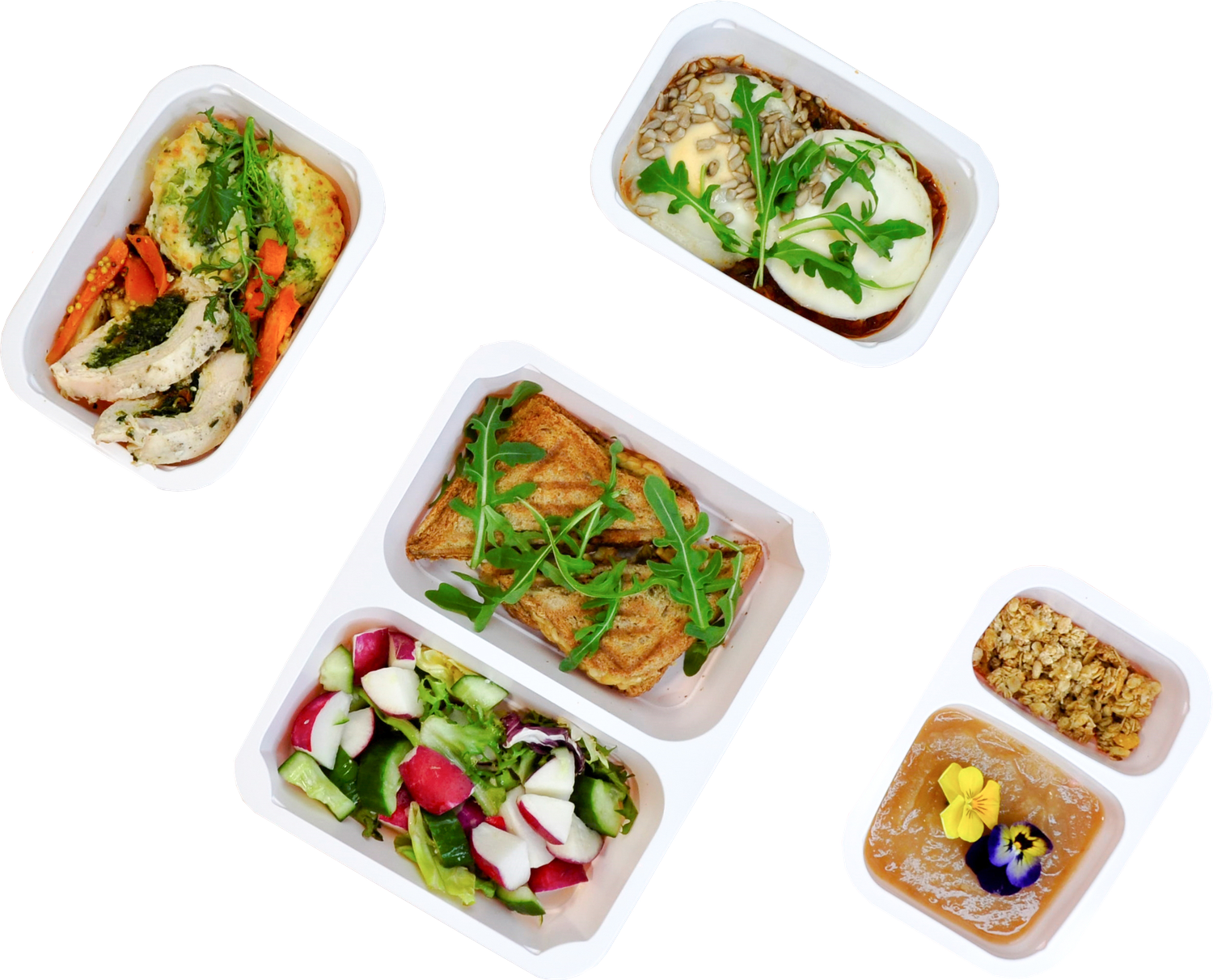
Przygotowane jedzenie dla klientów primate.diet
Z codziennymi dostawami zestawu posiłków można uniknąć korków i będzie to dużo tańsze niż kurier UberEats, który wiezie jedno danie. Po pierwsze, planowane dostawy w cateringu dietetycznym odbywają się poza godzinami szczytu, po drugie, dzięki użyciu samochodów-chłodni, rozwożone są wszystkie paczki na raz.
Wyobraź sobie usługę dostawy zestawu świeżych dań codziennie lub co drugi dzień, składającego się z 3 do 5 posiłków na dzień. Zestaw jest zbilansowany pod względem makroskładników, kalorii i alergenów, żebyś dostał swoją perfekcyjną kostkę rubika. Dzięki efektom skali, dużo wydajniejszej produkcji, firmy mogą oferować często takie zestawy wraz z kosztem dostawy w cenie jednego dania w lepszej restauracji.
W skrócie działa to tak: Klient zamawia przez internet – na stronie lub w aplikacji mobilnej. Każdego dnia otrzymuje spersonalizowany zestaw dań, dzięki którym może bezwysiłkowo zrealizować swoje cele. Model subskrypcyjny sprawia, że nie musi o niczym pamiętać. Właściciel biznesu ma bazę stałych, lojalnych klientów zamawiających po 5 dań każdego dnia. Dzięki braku ograniczeń geograficznych, może docierać do znacznie większej liczby odbiorców, a dzięki prostszej i tańszej produkcji uzyskać większą marżę. Brzmi, jak coś niemożliwego? Poznaj catering dietetyczny.
Perspektywa klienta:
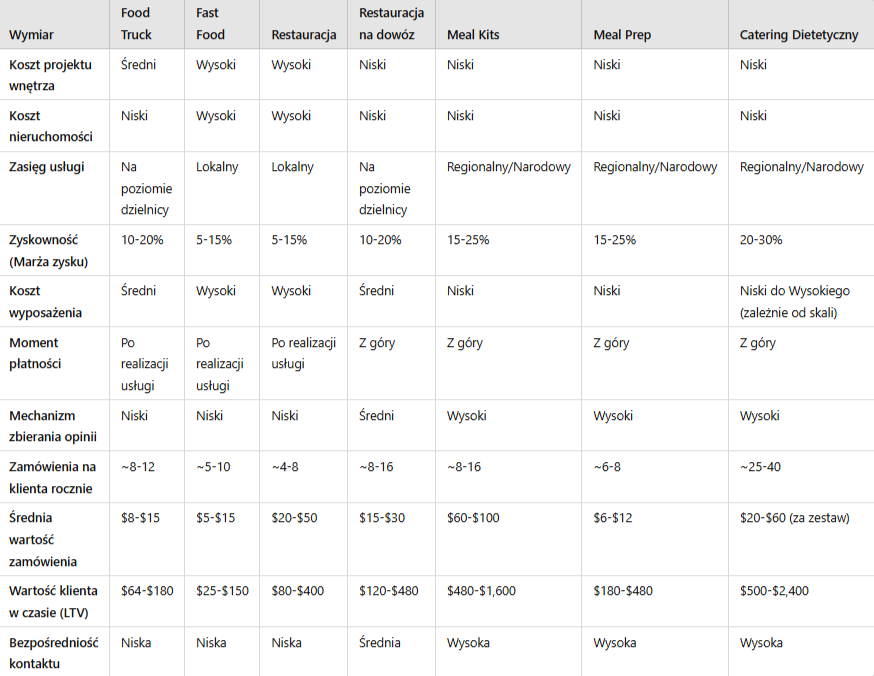
Legenda do Tabeli Klienta
Czy muszę robić zakupy?
Czy zakupy spożywcze są potrzebne jako uzupełnienie dostarczonego jedzenia.
Wartości: Tak, Nie.
Koszt
Jak drogi jest dany model z perspektywy klienta.
Wartości: Tani (przystępny cenowo), Średni (w średnim zakresie cenowym), Drogi (wysoki koszt).
Czas oczekiwania
Jak szybko jedzenie jest gotowe do spożycia.
Wartości: 5-10 min (Gotowe), 30-60 min, 60-120 min.
Dopasowanie do zdrowia
Jak bardzo jedzenie wspiera cele zdrowotne.
Wartości: Niskie (Smak najważniejszy), Średnie (Zbalansowane), Wysokie (Zdrowotne).
Czy mogę zamówić online?
Dostępność zamawiania online.
Wartości: Nie, Przez marketplace, Bezpośrednio.
Czy jedzenie jest świeże?
Świeżość dostarczanego jedzenia.
Wartości: Świeże, Schłodzone, Mrożone.
Czy muszę gotować?
Czy wymagane jest przygotowanie posiłku.
Wartości: Tak, Nie.
Przejrzystość składników
Jak dużo informacji o składnikach i wartościach odżywczych jest dostępnych.
Wartości: Tylko składniki, Składniki i alergeny, Pełna przejrzystość.
Wsparcie celów żywieniowych
Czy usługa wspiera specyficzne potrzeby dietetyczne.
Wartości: Nie, Częściowo, Tak.
Wysiłek związany ze sprzątaniem/naczyniami
Wysiłek wymagany po jedzeniu (np. mycie naczyń).
Wartości: Brak, Minimalny, Tak.
Wysiłek w planowaniu posiłków
Wysiłek potrzebny, aby zdecydować, co zjeść.
Wartości: Brak, Minimalny, Umiarkowany, Wysoki.
Legenda do Tabeli dla Właściciela Biznesu
Koszt projektu wnętrza
Odzwierciedla inwestycję wymaganą do stworzenia odpowiedniego wnętrza lub przestrzeni do przygotowywania posiłków.
Wartości:
Niski: Minimalna lub brak inwestycji (np. usługi dostawy).
Średni: Wymaga podstawowego przygotowania (np. food trucki).
Wysoki: Znaczna inwestycja w atmosferę i doświadczenie klienta (np. restauracje stacjonarne).
Koszt nieruchomości
Reprezentuje koszty związane z zapewnieniem przestrzeni do prowadzenia działalności.
Wartości:
Niski: Operuje z tanich lokalizacji, takich jak magazyny.
Średni: Wymaga pozwoleń mobilnych lub lokalizacji średniej klasy.
Wysoki: Wymaga premium lokalizacji (np. centra miast z dużym ruchem pieszym).
Zasięg usługi
Określa obszar geograficzny, który firma może skutecznie obsługiwać.
Wartości:
Lokalny: Ograniczony do najbliższego otoczenia.
Na poziomie dzielnicy: Obejmuje określony obszar miasta.
Regionalny/Narodowy: Możliwość skalowania na większe obszary, potencjalnie między miastami lub regionami.
Zyskowność (Marża zysku)
Odzwierciedla procent przychodów, który przekłada się na zysk po pokryciu kosztów.
Wartości:
5-15%: Niska do umiarkowanej marży (np. restauracje).
10-20%: Umiarkowane marże (np. food trucki, dostawy).
15-30%: Wysokie marże (np. zestawy posiłków, catering dietetyczny).
Koszt wyposażenia
Obejmuje wydatki na zakup lub wynajem niezbędnych narzędzi do przygotowywania i dostarczania posiłków.
Wartości:
Niski: Minimalne wymagania sprzętowe (np. meal prep).
Średni: Wymaga funkcjonalnego, ale przenośnego wyposażenia (np. food trucki).
Wysoki: W pełni wyposażone kuchnie do produkcji na dużą skalę (np. catering dietetyczny w większej skali).
Moment płatności
Określa, kiedy klienci dokonują płatności za usługę lub produkt.
Wartości:
Po realizacji usługi: Płatność dokonywana po skorzystaniu z usługi (np. restauracje, fast food).
Z góry: Płatność dokonywana z wyprzedzeniem (np. subskrypcje, zamówienia online).
Mechanizm zbierania opinii
Ocenia skuteczność zbierania informacji zwrotnych od klientów.
Wartości:
Niski: Ogólne recenzje bez szczegółowych informacji o daniach.
Średni: Opinie zbierane przez platformy dostaw.
Wysoki: Bezpośrednia i częsta informacja zwrotna od klientów na temat konkretnych posiłków lub doświadczeń.
Zamówienia na klienta rocznie
Średnia liczba zamówień składanych przez jednego klienta w ciągu roku.
Wartości:
Zależne od modelu biznesowego (np. 5-10 zamówień rocznie dla fast food, 25-40 zamówień rocznie dla cateringu dietetycznego).
Średnia wartość zamówienia
Reprezentuje typową kwotę wydawaną przez klienta na jedno zamówienie.
Wartości:
Zależy od modelu biznesowego (np. $5-$15 dla fast food, $20-$60 za zestaw w cateringu dietetycznym).
Wartość klienta w czasie (LTV)
Oblicza całkowity przychód generowany przez klienta w trakcie współpracy z firmą.
Wartości:
LTV = Zamówienia rocznie × Średnia wartość zamówienia (np. $25-$150 dla fast food, $500-$2,400 dla cateringu dietetycznego).
Bezpośredniość kontaktu
Opisuje poziom interakcji z klientami.
Wartości:
Niska: Ograniczony lub brak bezpośredniego kontaktu (np. restauracje stacjonarne).
Średnia: Częściowa interakcja za pośrednictwem platform (np. platformy dostaw).
Wysoka: Bezpośredni kontakt z klientem (np. catering dietetyczny, zestawy posiłków).
Zwycięzcy na Prochach Przegranych
Rynek zweryfikował gorsze modele biznesowe. Upadki były spektakularne
Freshly: zostało kupione za $1 miliard przez Nestle. Zamknęło działalność, ponieważ było nierentowne. Nie ważne, jak wielka skala – ten model po prostu nie działa.Źródło
Gorillas: początkowo rósł w zawrotnym tempie. Został kupiony przez turecki Getir, a następnie obydwa zniknęły z rynku. Getir działa tylko na rynku tureckim. Źródło
Chef’d: niegdyś z wyceną $150 mln. Już go z nami nie ma.Źródło
Munchery: działający w miastach takich jak San Francisco, Seattle, New York, nagle ogłosił bankructwo, ponieważ zadłużenie okazało się zbyt duże. Źródło
Plated: kupione przez sieć spożywczą Albertson i następnie zamknięte. Interesariusze uznali, że gotowe dania mogą sprzedawać bezpośrednio w sklepach. Źródło
Blue Apron: rok w rok notuje straty. Szukają opcji sprzedaży firmy lub fuzji z inną w celu ratowania. Źródło
Na polu cateringu dietetycznego sytuacja wygląda zgoła odmiennie.
Przykład liczby paczek dla klientów w primate.diet
Liczba firm osiągających zawrotne przychody na tym rynku rośnie. NTFY, Maczfit czy Kuchnia Wikinga to tylko kilka z przedsiębiorstw, które są na poziomie wyższym niż $50 000 000 rocznej sprzedaży (dane szacunkowe).
Ich marketing nie ustępuje rozmachem gigantom: zatrudniają celebrytów, sponsorują maratony, czy w przypadku Kuchni Wikinga nawet reprezentację w piłce nożnej.
Pomimo że nie miałem takiego zaplecza finansowego i wystartowałem znacznie później, udało mi się stworzyć markę cateringu dietetycznego, którą rozwinąłem do poziomu $200 000/miesięcznie w czwartym miesiącu działalności. Jeśli też chcesz otworzyć własny biznes jedzeniowy, koniecznie obejrzyj darmowy trening online.
Dlaczego nas oszukano? Dla pieniędzy.
Wmówiono nam, że zdrowe jedzenie jest skomplikowane. Pełno jest wokół nowych trendów: low-fat, low-carb, keto, paleo, posty przerywane. Wydaje się, że żeby prowadzić biznes ze zdrowym jedzeniem musisz serwować wyłącznie jagody goji na kokosowym mleku, przyprószone Acai. Panuje przekonanie, że zdrowe jedzenie jest drogie i udziwnione.
Jaka jest prawda? To znacznie prostsze, ale prostota nie przynosi zysków korporacjom, które nieustannie szukają nowych sposobów na sprzedaż swoich przetworzonych produktów.
“Zdrowe jedzenie” to tak naprawdę tylko 3 elementy:
Jakość – nieprzetworzona żywność. Jabłko, które zostało zerwane z drzewa, a nie wrzucone z puszki z syropem. Marchewka, która została wyrwana z ziemi, nie z laboratorium. Prosty i krótki skład produktów. Co powinna zawierać szynka? Mięso. Zawiera coś jeszcze? To nie jest mięso, tylko produkt mięsopodobny.
Proporcje – wszystko w odpowiednich proporcjach smakuje lepiej. Nie chodzi o jedno danie. Chodzi o proporcje tego, co zjadamy przez cały dzień. Zarówno w kontekście witamin, minerałów, jak i makroelementów. Po prostu po trochu ze wszystkiego. To może za Ciebie liczyć choćby aplikacja.
Ilość – to dawka czyni truciznę. Nawet wodą można się zatruć, jeśli wypije się jej za dużo – 6-10 litrów w ciągu kilku godzin może już być dawką śmiertelną. To tak samo, jak z wodą w wannie. Jeśli dolewasz szybciej niż zdąży wypłynąć – wanna jest coraz bardziej pełna. Jeśli dolewasz powoli – ubywa jej więcej niż zdążysz nalać.- Nie inaczej jest w przypadku odżywiania. Jeśli jemy za dużo – tyjemy. Jeśli jemy za mało – chudniemy. Tyle. Nie ma żadnej magii. Nie ma znaczenia czy kalorie pochodzą z tłuszczy, węglowodanów, alkoholu – jeśli jest ich za dużo, organizm je magazynuje. Jeśli jest ich za mało, spala dostępne zasoby.
Czy jest kogokolwiek, kto powiedział: “zostałem milionerem dzięki marketplace’om jedzeniowym?” Tak, ich założyciele i inwestorzy, którzy sprzedali akcje, gdy wchodzili na giełdę. Z całą pewnością nie byli to jednak przedsiębiorcy i właściciele restauracji, na których plecach owe marketplace’y zostały zbudowane.
Marketplace’y zapewniają mniejsze firmy, że te zyskają widoczność, ale prawda jest nieco inna. System został skonstruowany w taki sposób, że nie masz jak się wyróżnić swoją ofertą. Wciskają Cię w szablonowe kategorie, wystawiają na walkę cenową z konkurencją i przy okazji biorą Twoich klientów. Gdy Ty walczysz o przetrwanie, oni pochłaniają 30% każdej sprzedaży, a Ty nawet nie masz dostępu do adresu mailowego, ani numeru telefonu swoich klientów, żeby być w stanie się z nimi bezpośrednio skontaktować.
Jak to mówią programiści “it’s not a bug, it’s feature”. Te systemy zostały zaprojektowane w taki sposób, żeby działać przeciwko Tobie. Stajesz się od nich zależny, a to natomiast oznacza dla nich większe zyski.
Nie można winić kogoś, kto całe życie spoglądał przez zasłonięte okno
W społeczeństwie panuje romantyczna wizja. Marzenia o własnym biznesie jedzeniowym, zazwyczaj restauracji, gdzie właściciel spotyka się ze znajomymi, sączy winko na tarasie, patrzy na piękny zachód słońca. Ma miejsce, którym może pochwalić się przed znajomymi i przyjemnie spędzić czas. Jest to marzenie, które szybko przeradza się w finansowy koszmar.
Jeśli na tym etapie masz poczucie, że cokolwiek zrobiłeś źle – nie miej. Ilość informacji, którymi jesteśmy bombardowani każdego dnia, żeby promować tę wizję, sprawia, że nawet najbardziej wprawny obserwator może zostać zwiedziony na manowce.
Poznałem parę hodowców bydła, którzy mieli dość produkcji rolnej i postanowili spełnić właśnie marzenie o biznesie gastronomicznym. Nie mieli pojęcia o tym, jak nim zarządzać. “Na szczęście” przejęli biznes wraz z personelem w skład którego wchodzili: menedżer, szef kuchni, kucharze. Wydawało się, że to “ziemia obiecana”, i że wkrótce z intratnej, acz wyczerpującej produkcji rolnej, będą mogli w pełni przerzucić się na gastronomię. Zwrócili się do mnie, ponieważ biznes wkrótce po przejęciu stał się nierentowny. Gdy zacząłem z nimi rozmawiać, na jaw wychodziły niepokojące fakty: foodcost 40%, zamówienia wyłącznie od jednego dostawcy, biznes zarządzany przez pracowników, umowa skonstruowana tak, że menedżer nie miał żadnej pensji od zysków.
Personel przekonał ich, że to przejściowe, że teraz nie ma sezonu, że to dlatego że produkt jest najwyższej jakości i szereg innych rzeczy. Mitów, które panują na tym rynku jest mnóstwo i opisałem je szerzej w 23 Największe Mity Związane z Zarządzaniem Gastronomią. Ostatecznie menedżer i zespół nakłonili właścicieli, żeby nic nie zmieniać, bo sytuacja wkrótce się odwróci i tak zostali z romantycznym marzeniem i finansowym koszmarem.
Niektórzy kupują jachty, inni samochody, są tacy co kupują restauracje. Łączy ich jedno – zdecydowana większość z nich do tych biznesów dokłada.
Jeśli zatem zależy Ci na zbudowaniu rentownego biznesu jedzeniowego, restauracja – bez względu, czy będzie to fast-food, lokal wyłącznie z dostawą, czy z jedzeniem na miejscu – nie jest najlepszym pomysłem. Zasadniczo ma największe szanse się nie udać. 60% upada w ciągu 2 lat, 80% w przeciągu 5 lat i ze względu na brak możliwości skalowania, najmniejsze szanse na to, że będzie biznesem choćby milionowym.
Prawdy są uniwersalne.
Są one ponadczasowe i takie same dla wszystkich kultur. Nie ważne, czy mieszkamy na bliskim wschodzie, czy dalekiej północy, wszyscy chcemy mieć więcej czasu dla siebie i rodziny. Pragniemy nie tylko żyć dłużej, lecz także być zdrowsi, pełni energii, żyć w sprawnym ciele, nie robić rzeczy, których nie lubimy, jak np. stać w korkach, gdy może to zrobić kurier, sprzątać, gdy nie jest to niezbędne, gotować, jeśli można od razu jeść i ostatecznie – mieć poczucie bezpieczeństwa – w końcu tutaj chodzi o nasze życie. Chcemy wiedzieć, co wkładamy do ust i jak to zostało wyprodukowane.
Dotychczas było tak, że restauracje miały trzy podstawowe grupy kosztów: żywność (zazwyczaj 28 do 32 procent całkowitych kosztów), koszt wynagrodzeń (kolejne 28 do 32 procent) oraz opłaty związane z obłożeniem lub nieruchomościami (22 do 29 procent). Patrząc na jednostkową ekonomię restauracji, biznes powinien operować w zakresie od 78 do 93 procent – pozwalając na marżę zysku od 7 do 22 procent (restauracje franczyzowe płacą dodatkowe opłaty franczyzowe na rzecz korporacji). Źródło
System jest skonstruowany tak, że: właściciel nieruchomości zarobi, franczyzodawca zarobi, marketplace zarobi, zaś właściciel restauracji, który ma pomysł, wkłada pracę, kapitał i ryzykuje najwięcej, jeśli w ogóle odnotuje zyski, to niewielkie. W sytuacji, gdy coś pójdzie nie tak (jak choćby zamknięcia lokali w trakcie covid), dostaje wypowiedzenie umowy najmu, franczyzy, współpracy i zostanie podmieniony na inny trybik machiny.
Nie buduje się domu na wynajętej ziemi i tak samo nie można uzależniać przyszłości swojego biznesu od innych podmiotów. Czy wiesz, że McDonalds tak naprawdę nie zarabia na sprzedaży hamburgerów? Zarabiają na nieruchomościach. Są właścicielami ziem na których stoją McDonaldsy, a następnie wynajmują je franczyzobiorcom. Oni wiedzieli to już dawno i przez lata konsekwentnie realizowali tę strategię. Źródło
Tylko od nas będzie zależało czy będziemy dalej napełniali kieszenie molochów zarabiających na pasji kulinarnych przedsiębiorców. Musimy budować własne, niezależne kanały kontaktu z klientem i odpowiadać na jego potrzeby w najprostszy i najwygodniejszy dla niego sposób. Sprzedaż przez własną stronę internetową, aplikację mobilną, telefon, maila – to wszystko są narzędzia, których nikt nam nie odbierze. Instagram, Facebook, WhatsApp, YouTube mogą jutro uznać, że Twoje konto nie spełnia ich polityki i je zamknąć. Nie znaczy to, że nie powinieneś z nich korzystać. Płatne reklamy pozwalają na szybkie skalowanie biznesu. Jeśli jednak jesteś w stanie skontaktować się ze swoim klientem samodzielnie, bez pośredników przychody Twojego biznesu będą bezpieczne. Więcej napisałem o tym w tymartykule.
Prywatny Kucharz Na Wyciągnięcie Ręki, a Raczej Smarthphone’a
Smaczne, dopasowane do potrzeb klienta jedzenie w przystępnej cenie na co dzień. Czy jest ktoś kto nie chciałby mieć prywatnego szefa kuchni? Każdy chciałby mieć, ale mało kogo stać. Catering dietetyczny, to właśnie taki prywatny szef kuchni, który dzięki temu, że gotuje dla dziesiątek, setek czy nawet tysięcy osób jednego dnia, jest w zasięgu finansowym przeciętnej osoby.
Model jest świetny do prowadzania, ponieważ jest świetny dla klienta. Przyjrzyjmy się, jak odpowiedź na potrzeby klienta sprawia, że przedsiębiorcy zostaje w portfelu więcej pieniędzy i jest on w stanie niezwykle szybko skalować ten biznes.
Masowa personalizacja jest prosta i tania, jeśli wie się, jak ją wdrożyć. W cateringu dietetycznym gotuje się od kilku do nawet kilkuset różnych dań dziennie. To oznacza, że z tak rozbudowanego menu, odbiorca zawsze jest w stanie wybrać zestaw optymalny, który spełnia jego oczekiwania nie tylko pod względem smakowym, lecz również pod względem wykluczenia składników, których jeść nie chce lub nie może, dopasowania do zasobności portfela czy zbilansowania zestawu pod względem zarówno kalorii, jak i makroskładników. Pamiętasz kostkę rubika? Tak w praktyce wygląda jej rozwiązanie.
Czy teraz sobie myślisz: “ale jak to wszystko ze sobą pogodzić? Przecież możliwych kombinacji jest więcej niż gwiazd na niebie!”? W pełni Cię rozumiem. Gdy zaczynałem mierzyliśmy się z tym samym wyzwaniem i dlatego postanowiliśmy je rozwiązać. Powiem wprost – bez odpowiednich narzędzi optymalizacja takiego wyboru, ręcznie, jest niemalże niemożliwa.
We Flambii, stworzenie i poprawienie algorytmu, który brałby te wszystkie elementy pod uwagę, pogodził interesy klienta i realia produkcji, zajęło nam 5 lat. Dzięki połączeniu doświadczenia produkcyjnego, programowania i kombinatoryki okazało się to możliwe i ostatecznie rozwiązaliśmy ten problem za pomocą dedykowanego oprogramowania.
Poza dopasowaniem do swoich preferencji, klient oczekuje przystępnej ceny, najlepiej niewiele wyższej niż koszt ugotowania w domu oraz darmowej dostawy, bo jak wiemy, nikt nie lubi za nią płacić. Jeśli pracowałeś dotychczas w gastronomii, masz prawo pomyśleć: “to absolutnie niemożliwe, wiem, ile kosztuje mnie wyprodukowanie dania w restauracji”. No właśnie, przyjrzyjmy się różnicom i dlaczego danie w cateringu dietetycznym może być tańsze niż gotowane w domu. Klienci cateringu dietetycznego zamawia 4-5 dań dziennie. To powoduje, że liczba produkowanych dań staje się olbrzymia już przy stosunkowo niewielkiej skali. W moim cateringu, mając 2000, klientów kuchnia de facto produkuje blisko 10 000 dań dziennie.
Praca
Kucharz, gotując zupę w restauracji, jest w stanie ją przygotować dla kilku, najwyżej kilkunastu klientów. Kucharz w cateringu dietetycznym użyje wielkiego kotła warzelniczego, gdzie może gotować na raz 500 litrów zupy. Kucharz restauracyjny musi przygotowywać dania na świeżo dla klientów zamawiających czy to na miejscu czy w dostawie, o różnych godzinach. Przez co wykonuje te same czynności po kilka, kilkanaście razy dziennie. Kucharz cateringowy robi dane danie jeden raz. W kuchni restauracyjnej, prep, czyli przygotowanie składników, to praca manualna. Przy skali cateringu dietetycznego, opłaca się to zautomatyzować, i w ten sposób: krojenie, siekanie, obieranie, mycie, ścieranie, mielenie – odbywa się przy pomocy maszyn kuchennych, zaś rola kucharza sprowadza się do tego, co najważniejsze – czuwania nad smakiem potraw i umiejętnego połączenia składników.
Media
Dzięki takiemu modelowi produkcji, nakład pracy, zużycie prądu czy gazu, a także ilość strat w żywności per danie są nieporównywalnie mniejsze. Co więcej, procesy są ustandaryzowane, co zapewnia lepszy, powtarzalny smak dań. To wszystko pozwala zaproponować odbiorcom produkt końcowy w bardziej atrakcyjnych cenach, niż byliby w stanie uzyskać nawet samodzielnie gotując w domu. Po drugie marża przedsiębiorcy jest nieporównywalnie wyższa i sięga 50% czy nawet 60% per danie z zachowaniem świetnego smaku i wysokiej jakości.
Dostawy
Kolejnym elementem który zapewnia cateringom dietetycznym oszczędności, są efektywne dostawy. W restauracji kurier działa w modelu punktowym (“point-to-point”). Oznacza to, że zawozi przesyłkę, wraca na bazę, zawozi kolejną przesyłkę. W cateringu – operuje w systemie trasowym (“milk run”), tj. zabiera wszystkie paczki na raz i rozwozi je po kolejnych punktach. Podróżuje poza godzinami szczytu – albo wcześnie rano, zanim ludzie wyjdą do pracy albo późno po południu lub wieczorem, gdy są już w domach. Nie stoi w korkach i jest w stanie dużo szybciej przemieszczać się po mieście. Dysponuje również dużo większą ładownością i jest w stanie obsłużyć nawet do 150 zamówień za jednym razem kontra do 5 zamówień w przypadku restauracji – 30x więcej! Mało tego, punkty dostaw takiego kuriera są z góry znane, co pozwala na zoptymalizowanie trasy dostawy. Jeśli do tego przypomnimy sobie, że każdy klient zamawia 4-5 dań dziennie, nie jak w przypadku restauracji 1-3, uświadamiamy sobie, że koszt dostawy per danie jest znikomy w porównaniu z tradycyjnym modelem dostaw oferowanym przez aplikacje typu UberEats. Zasięg dostaw kuriera UberEats to kilka kilometrów. Nawet na samym początku działalności, catering dietetyczny jest w stanie obsługiwać cały obszar miasta o średniej powierzchni. Wraz ze wzrostem skali, staje się opłacalne dostarczanie pomiędzy miastami, dzięki wyspecjalizowanej flocie aut chłodniczych. Dania w moim cateringu codziennie są dostarczane do klientów w całej Polsce, pokonując setki kilometrów, a wszystko to powstaje w jednej kuchni centralnej.
Paczki dla klientów moich dwóch cateringów dietetycznych: Cebulka i Primate
Nieruchomość
Jednym z kluczowych elementów kosztowych w przypadku restauracji jest nieruchomość. Nie w przypadku cateringu dietetycznego. Kiedy zaczynałem, startowaliśmy z kuchni w mieszkaniu kolegi. Oczywiście nie jest to model skalowalny i byliśmy w stanie tak działać do 30 paczek dziennie. Szybko musieliśmy poszukać czegoś profesjonalnego. Tu dochodzimy do gigantycznej różnicy pomiędzy omawianymi modelami – restauracja musi być blisko centrum. Jeśli jest to sit-in, aby lokalizacja była atrakcyjna. Jeśli jest to typ delivery – żeby kurier nie jeździł daleko. Takie lokalizacje są bardzo kosztowne. W przypadku cateringu dietetycznego zależy nam jedynie, żeby kuchnia była wystarczająco przestronna. Tyle.. Idealnie sprawdzą się hale przemysłowe, przystosowane do gotowania. Miejsca na uboczach są dużo tańsze w najmie i w adaptacji, niż te w centrum. Koszt najmu lokalu jest kosztem dalece mniej istotnym w cateringu dietetycznym, niż restauracji.
Tak na początku wyglądał obszar przygotowywania paczek
Foodcost
Koszt surowca również będzie nieporównywalnie mniejszy, a jakość wyższa, ponieważ pomijasz pośredników. Przy tej ilości nie kupujesz jedzenia w sklepie, tylko u wyspecjalizowanych dostawców hurtowych, którzy dowiozą produkt na Twoją kuchnię. Będziesz korzystał z podobnych lub tych samych dostawców, co sklepy wielkopowierzchniowe i tym samym uzyskasz dużo niższe ceny oraz wpływ na jakość produktów, o której nie może marzyć prawie żadna restauracja. Z perspektywy handlowca takiej firmy, jesteś wart tyle co 10 restauracji. Zrobi więc wszystko, żeby zatrzymać Ciebie jako klienta.
Smak
Podstawową rzeczą, na której zależy klientowi jest smak potraw. Ile dni z rzędu byłbyś w stanie jeść w restauracji, zanim serwowane tam dania znudziłyby Ci się, a potem całkiem obrzydły? Catering dietetyczny ma tę unikalną przewagę, że dań w menu jest kilka do kilkuset dziennie – im większa skala działalności, tym większy wybór. Oznacza to, że nie dość, że klient dopasowuje dania pod swoje gusta, to jeszcze nie ma mowy o nudzie. Takiej różnorodności nie sposób doświadczyć w domu, bo nikt nie ma czasu gotować dla siebie codziennie 5 różnych posiłków. To jak z jazdą komunikacją miejską i autem. Pamiętasz, jak kiedyś nie miałeś prawa jazdy i podróż metrem czy autobusem nie wydawała się problemem? Ale teraz, jak już masz samochód, jesteś gotów płacić 10x więcej za komfort jazdy na własnych zasadach, przy ulubionej muzyce, w godzinach jakie są dla Ciebie dogodne, bez konieczności spaceru z przystanku do miejsca docelowego, bo dojeżdżasz pod same drzwi. Tak samo jest w tym przypadku – kto raz zasmakuje wygody cateringu dietetycznego, nieprędko wróci do starych zwyczajów.
Przykłady dań w cateringu dietetycznym Cebulka
Feedback
One of the eternal challenges for chefs is figuring out where and how to gather structured feedback on what customers like and what needs improvement. Have you ever seen a situation where customers, when asked about their experience, politely said everything was fine, but never returned to that restaurant again?
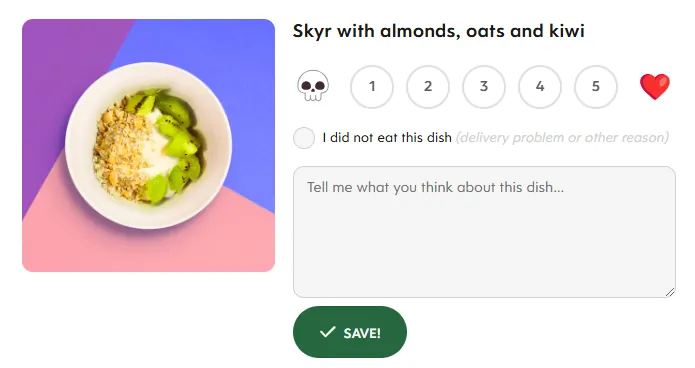
In diet catering, customers can rate individual dishes, leave comments, and provide suggestions via the website or mobile app without feeling like they’re hurting the feelings of a kind server. This provides the kitchen with continuous feedback—not anecdotal insights from one or two customers but structured input from hundreds. This allows for consistent recipe refinement and improvement.
W ten sposób klienci oceniają dania w naszym systemie. Oceny otrzymujemy natychmiast.
Informacja zwrotna
Dodatkowo, odwieczny problem szefów kuchni – skąd i w jaki sposób zbierać uporządkowane informacje, o tym, co klientom smakuje, a co należy poprawić? Nie wiem jak Ty, ale byłem świadkiem sytuacji, w których ludzie zapytani, o ich odczucia, z grzeczności odpowiadali, że wszystko w porządku, a potem już nigdy więcej nie wrócili do tej restauracji. W cateringu klient ocenia poszczególne dania, daje komentarze i uwagi na stronie internetowej lub w aplikacji mobilnej, bez poczucia, że rani uczucia tego miłego kelnera. Dzięki temu kuchnia jest ciągle karmiona informacją zwrotną nie anegdotyczną, od jednego czy dwóch klientów, tylko setek, w powtarzalny, ustrukturyzowany sposób, co umożliwia stałe usprawnianie receptur.
Płatność z góry
Jedną z największych bolączek branży są ciągłe problemy z płynnością finansową. Branie towaru na kredyt, stresowanie się, czy w tym tygodniu będzie dostatecznie dużo klientów, żeby zapłacić zaległości dostawcom. Do tego jest mnóstwo innych wydatków, na których pokrycie trzeba mieć gotówkę: drobne lub większe naprawy, wymiana regularnie zużywającej się zastawy, środki czystości i wiele innych, o których na co dzień nie myślimy, a które zsumowane tworzą górę zobowiązań. W cateringu dietetycznym część z tych kosztów również występuje, ale z jedną znaczącą różnicą – masz gwarancję tego, że usługa jest opłacona. Jak trudno mieć w dzisiejszych czasach gwarancję czegokolwiek? A tutaj, proszę – realizujemy opłaconą z góry usługę! Kupujesz towar, nie z nadzieją, że ktoś przyjdzie spróbować Twoich dań, tylko z myślą, że klient zapłacił Ci za Twój produkt i pracę. Środki, które otrzymujesz od klientów, możesz przeznaczyć na dalszą inwestycję w biznes. Jest to nieoprocentowany, darmowy kredyt.
Reklama i marketing
Jak wygląda reklama typowej restauracji? Trudno tu mówić o efektywnych działaniach. Ulotki, potykacze, posty na IG mimo, że konieczne, są trudne do zmierzenia pod względem zwrotu z inwestycji. W sprzedaży jedzenia w dostawie jesteś zdany na opłaty za zwiększenie widoczności w aplikacji marketplace. Nie masz kontroli nad tymi działaniami, skuteczność jest ograniczona. Nie jesteś w stanie zwiększyć skali działalności nawet 3-krotnie, nie mówiąc o wzroście 10x czy 100x. Ponieważ w cateringu dietetycznym klient zamawia w wygodny dla siebie sposób przez stronę internetową lub aplikację mobilną, możesz w bardzo łatwy sposób prześledzić ścieżkę użytkownika i zrozumieć, które działania są efektywne, a które nie. Do dyspozycji masz całe spektrum działań reklamowych, jak email, marketing afiliacyjny lub płatne reklamy na YouTube, Facebooku czy Instagramie. Właśnie dzięki tym ostatnim udało mi się pozyskać 2000 klientów już w czwartym miesiącu działalności – wiedziałem, ile mogę wydawać na pozyskanie klienta i inwestowałem pieniądze, które klienci przedpłacili, na pozyskanie kolejnych. Jeśli interesuje Cię temat efektywnych działań reklamowych, przeczytaj ten artykuł, z tego natomiast się dowiesz, jak liczyć ich opłacalność
Dobre dla ciała, dobre dla duszy
Dużo powiedzieliśmy o elementach bardzo technicznych, twardych, policzalnych, ale jak wyliczyć szczęście, wypalenie zawodowe, bycie wyspanym, poczucie, że komuś pomagasz? Te wszystkie rzeczy są trudno uchwytne, jednak ważne dla każdego z nas. Gdy zakładamy biznes, zależy nam, żeby był rentowny, ale chcielibyśmy mieć poczucie, że zostawiamy po sobie jakieś dziedzictwo. Coś co będzie mówiło o nas w dobrym świetle rodzinie, znajomym, innym ludziom, następnym pokoleniom.
Czy wiesz, co jest najczęstszą przyczyną zgonów na świecie? Nowotwory? Nie, zgaduj dalej. Covid? Nie jest nawet w pierwszej dziesiątce. Otóż to, co zabija 32% ludzi na całym świecie, to choroby układu krążeniowego. Mniej więcej połowa z tych chorób wynika wprost z nieprawidłowego sposobu odżywiania. Aż 16% wszystkich zgonów na świecie można by uniknąć, gdyby ludzie po prostu stosowali zdrową i zrównoważoną dietę! To jest 8,5 mln ludzi każdego roku. 23 287 ludzi dziennie umiera, bo jadło burgery, chipsy i zapijało to wodą z cukrem i barwnikiem, zamiast Twojego pysznego jedzenia. Źródło, źródło, źródło.
Gdy sobie to uświadomiłem, zrozumiałem, że to nie chodzi tylko o sprzedaż jedzenia i czy porcja frytek będzie pojedyncza czy podwójna. Tutaj chodzi o to, że poprzez dostarczanie smacznych, zbilansowanych zestawów możesz sprawić, że tysiące dzieci nie będzie sierotami, że ktoś nie straci przedwcześnie brata czy siostry. Poprzez jedzenie sprawiasz, że całe społeczności cieszą się lepszą jakością i dłuższym życiem!
Koniec z nieludzkim warunkami pracy w gastronomii, pracy po 12, 14 czy nawet 16h. W cateringu proces produkcji działa, jak w zegarku. Całość jest przewidywalna i zaplanowana z góry. Dzięki temu zespół może przyjść do pracy, zrobić swoje i iść do domu, pracując równym tempem przez cały dzień, zamiast gonić w piętkę, bo zaczęła się pora obiadowa i restauracja jest oblegana a pracowników i sprzętu brakuje.
Ostatnią zaletą jest ogólny wpływ na środowisko. Począwszy od tego, że kurier nie jeździ bez sensu, zużywasz dużo mniejszą ilość energii w trakcie przyrządzania menu, a jedzenie nie marnuje się ani na produkcji, ani u klienta, który otrzymuje odmierzone porcje na każdy dzień.
Ta fala odpływa. Posurfujesz na jej szczycie lub zostaniesz na środku oceanu
Jak sam widzisz, catering dietetyczny jest atrakcyjnym modelem dla klienta i dla przedsiębiorcy – jest tańszy, wygodniejszy, szybszy, bardziej dostosowany do preferencji smakowych i zdrowotnych, w odróżnieniu od restauracji, gdzie dla poprawy walorów smakowych jest dodawana duża ilość tłuszczu, a kucharze choć potrafią robić dania pyszne, o dietetyce nie mają pojęcia. Wszystko to sprawia, że wizja osobistego szefa kuchni dostępnego dla każdego jest jak najbardziej realna i ze względu na zmiany w społeczeństwie, szybko zyskuje na popularności.
Z tego co widzę na różnych rynkach, nie będzie mnóstwa takich podmiotów, jak w przypadku restauracji. Występuje tutaj prawo pierwszeństwa na rynku. Kto pierwszy zacznie prowadzić ten biznes w danym regionie, będzie szybko zyskiwał masę, efekty skali, rozszerzał ofertę i tworzył gigantyczne bariery wejścia dla konkurencji. Z tego względu, jeśli nie wskoczysz na tę falę teraz, zostaniesz na środku oceanu i pozostanie Ci dryfowanie.
Jeżeli chcesz chcesz być jednym z nielicznych, którym będzie dane zadomowić się na wschodzącym rynku cateringów dietetycznych – obejrzyj darmowy trening i podążaj za dalszymi instrukcjami.
“Paweł, Paweł, come quickly, you have to see this!” – my Aga called out to me with a tone that mixed disbelief and fear.
“What happened? I’m kind of busy,” I replied, thinking it was just another internet drama, something like: “a politician said something compromising or outrageous” – just another day in the world.
She showed me her phone with a news article.
“Paweł, the whole world is being locked down. There’s some epidemic that came to us from Wuhan, China.”
We’d already had other epidemics before: bird flu, mad cow disease, swine flu, and others. My first thought was that it was just another media-driven topic. Surely, there was no way they could lock the entire world at home, right?
The information had been circulating earlier, but at a much lower intensity. We don’t watch TV. At the time, we were on a family trip to Gdańsk, relaxing and working by the sea. Most global news had flown under our radar until it began to affect us directly. Suddenly, news of the epidemic was everywhere: our Facebook feeds, Instagram, email inboxes. The world froze.
The government announced the introduction of a state of epidemic threat:
“We are implementing safety measures in connection with the coronavirus, including restrictions on movement. However, the obligation to stay at home will not apply to commuting to work or taking care of essential daily needs such as buying food, medicine, or caring for loved ones. We want Poles to avoid putting themselves and others at risk of coronavirus infection.”
We stared at each other in silence, reading more articles and comments in disbelief. When it finally sank in that this was real and already decided, I didn’t feel a fear of suddenly getting sick. I had read that those most at risk were people with weakened immune systems, mainly the elderly and those with obesity.
Thoughts began to sprout in my mind:
“How will work look now?”
“How will kids go to school?”
“Will there be any problems with food availability?”
Few days before the lockdown. On our trip in Gdańsk.
The Only Constant Is Change
Closed restaurants, shops letting in one person at a time, and massive queues outside. The situation escalated day by day.
Business and startups are my interests, so I was curious to see how the market would respond to these events. The quick commerce category exploded—food delivery in 10 minutes became the new trend.
In Europe, Gorillas led the way, becoming the fastest company in history to achieve unicorn status, valued at $1 billion just 9 months after its founding.
Restaurants that didn’t go bankrupt and were fighting to survive turned to marketplaces to enable deliveries to their customers. However, the cure turned out to be worse than the disease. Marketplace commissions, reaching up to 30%, effectively wiped out any margin for restaurants. It became clear that customers using these apps stayed loyal to the marketplaces, not the restaurants. Attempts to encourage direct orders bypassing intermediaries largely failed.
Millions of hospitality workers lost their jobs. A significant portion switched industries, for example, becoming couriers, as demand for them surged due to the rapid growth of e-commerce. Once restrictions were lifted, the food service industry faced a severe challenge: a lack of skilled staff, many of whom had found work in other sectors.
Because supply (chefs seeking jobs) was smaller than demand (restaurants looking for chefs after reopening), wages rose dramatically, in some cases doubling within 2–3 years.
Geopolitical events, like the war between Russia and Ukraine, drove up fuel and energy prices, significantly affecting food truck businesses and food startups. This, in turn, caused logistics costs—and consequently food prices—to skyrocket. Restaurant prices, both for dine-in and delivery, rose to a level that made eating out unaffordable for much of the population, influencing many to seek affordable meal prep options or start a catering business that offers value. While weekends still saw people visiting restaurants, weekday traffic and orders dropped, as wages failed to keep up with inflation.
The world was changing before our eyes. Alongside growing challenges, new needs emerged. Everyone realized how precious health is. Who among us doesn’t know at least one person saying they need to take better care of themselves, whether through exercise or healthier eating? Around 70% of people say they’d like to eat healthier, which is a significant opportunity for starting a health-focused food business in 2025. At the same time, the number of people with dietary restrictions increased significantly. The most common are avoiding meat or all animal products, but there’s also a growing demand for foods tailored to religious needs, like halal, or fitness goals, like high-protein meals.
Designing a menu tailored to individual needs is an art—like building a LEGO set with a million pieces, many of which are damaged or don’t fit. This is particularly important when considering how to start a meal prep service that meets diverse dietary needs. There are more food products available now than ever, but finding, selecting, calculating, and cooking the right ones is no small feat. It’s like searching for a needle in a haystack—there are endless options, but very few match our needs and lifestyle. Without enough time and knowledge, creating a proper daily menu feels almost impossible.
We dream of a beautiful treehouse, but amidst the chaos of life, it often ends up as a mess, leaving us feeling far from satisfied.
How it usually goes — a box of loose bricks and no plan.What we were aiming for all along.
Switching to remote work disrupted the monotony of our daily routine—the grind of spending an hour commuting to work, 8 hours at a desk, another hour traveling to the store, an hour shopping, an hour cooking, an hour cleaning, and then off to bed, only to repeat it all again.
It turned out that for many, remote work was far more convenient, and commuting to the office wasn’t as necessary as we once believed. Similar changes occurred in our approach to shopping and eating—we suddenly realized: “Someone else can do this for me, and I gain time for the things I enjoy.”
The Aftermath: Four Key Trends Reshaping How We Eat and Impacting Food Business Ideas in 2025
Health
Yoga studios, CrossFit boxes, and gyms are sprouting up like mushrooms after the rain. Marathons have become a staple of urban life, and sales of supplements are breaking records. Moreover, 70% of people actively seek healthier food options. Eating is no longer just about taste—it’s now a way of taking care of both body and mind.
Convenience
We live in the age of subscriptions—from Netflix and Spotify to gyms and phones. It’s all about the “set it and forget it” mentality. Why? Because it’s convenient. We want to minimize effort, and convenience now dominates our culinary choices as well, pushing the growth of food startups focusing on ready-made meals and meal prep services. We don’t want to plan meals or cook when we can have ready-made solutions delivered right to our door.
Transparency
It’s not just about how food is produced—whether it’s ethical, sustainable, or where it comes from. While we claim these issues matter, companies like Shein, notorious for breaking every standard, continue to thrive. In food, transparency has become more personal: What exactly is in this product? Does it contain sugar? How much protein does it have? Is it vegan? Consumers demand clear, specific information to make informed decisions, which is crucial for anyone starting a food business that aims for transparency.
Time-Saving
Fast. As fast as possible. We live at the speed of immediacy. Smartphones are with us 24/7, and platforms like TikTok, Instagram, and Facebook have taught us that everything needs to be “here and now.” If I can’t order something with two clicks, I just scroll on. Why drive to the store, sit in traffic, or battle crowds when a courier can do it for me? This need to save time fuels the growth of delivery apps and platforms, presenting an opportunity for starting a food business focused on quick, convenient delivery.
More than half of us changed our eating habits after the COVID pandemic, but only one in three people is satisfied with the offerings in restaurants and stores. Most of us feel misled about the composition and contents of products, clearly indicating a need for transparency and clear product labeling:source.
We are often bombarded with choices of dishes, how do we decide on the single best one?
Is It Possible to Tame the 4 Horsemen of the Apocalypse?
At this point, it was clear to me that the modern food business is not tailored to the needs of our times. I analyzed all the business models available in the market. Each of them fulfilled at most two out of the four expectations.
Food delivery isn’t as fast as it might seem. Apps are designed to showcase restaurants, not dishes. Who’s interested in restaurants? Show me the menu and don’t make me sift through a Yellow Pages of businesses! From the moment you place an order, delivery can take up to two hours, and the food arrives barely warm. You know what? I order food because I’m hungry now, not in two hours!
Is it better at a restaurant? My wife can’t eat dairy. Ordering is a real nightmare. Good luck finding out which dishes don’t contain dairy. Waiting times and prices make it more of a weekend pleasure than a daily solution.
Other models have emerged too, such as meal kits popularized by companies like HelloFresh, Blue Apron, and others. These are fantastic for people who have time and enjoy cooking. You can order one for the weekend and spend time cooking with family and friends. However, for people aged 20-40 focused on their careers, this solution is entirely unsuitable. They’re simply not home and don’t have time to cook during the week.
Then there’s the meal prep category, which is essentially the same as buying ready-made meals in the supermarket, except they’re delivered to your home. Meals arrive once a week. Are they still fresh and healthy after a week? Let’s answer that question ourselves, especially since some companies deliver frozen meals. How is this convenient? Are you going to bring a carton of frozen dinners to work? And what about breakfasts or something for the evening? There’s nothing. One way or another, you still have to go to the store. So why not just buy ready-made meals there in the first place?
Estimates for such a meal for two adults and a child are as high as $100.
Then it hit me. What we need is not mass production but mass personalization! Mass production allows for creating meals at a price affordable to the average person, while personalization ensures that the diverse needs of each of us are met.
While you’re fighting to survive, they’re taking 30% of every sale, and you don’t even have access to your customers’ email addresses or phone numbers to contact them directly.
Let’s pause here for a moment. What needs? Food is just food, right? I was hungry, now I’m full—mission accomplished. This couldn’t be further from the truth. Each of us has specific needs and expectations when it comes to eating.
Some people look to food to improve their physique, whether to lose weight or gain muscle. Others, for religious or ideological reasons, exclude certain products, like meat, pork, or require that meat be produced in a particular way—halal, for example. Then there are those with allergies, like nuts, or conditions like celiac disease, which make them unable to eat gluten. More and more people are noticing lactose intolerance. We avoid bloating products like onions, garlic, or brussels sprouts.
Running a diet catering service taught me that a significant portion of clients detest olives—it’s the most common exclusion in primate.diet, though I have no idea why. If any olive-haters could explain this in the comments, I’d be grateful.
On top of all that, we all want to eat deliciously without overspending. Add to this the need for variety; sometimes we want something portable, like a smoothie, while on cold days we crave a warm soup. Factor in calorie counting, the wide-ranging needs of our families, leftovers in the fridge, and the eternal question: “What should we have for dinner?”
What we end up with is a multidimensional Rubik’s Cube we try to solve every day. And rarely with fully satisfying results.
Diet Catering – the Holy Grail of Gastronomy
The perfect solution would be hiring a personal chef to cook exactly what we want for the entire day, in the exact portions we need, without the dreadful ingredients we want to avoid (begone! cried olive haters in unison). However, having a dedicated person shopping and cooking for just one client is far from economical—most people simply can’t afford it.
But what if a single chef could cook for 10, 100, or even 1,000 pre-planned customers? Since the chef knows in advance what to prepare, they can plan production efficiently and do everything once instead of dozens of times throughout the day, as is typical in a restaurant.
It takes the same amount of time for a chef to put one chicken breast in the oven as it does to cook an entire tray of 100 breasts. The same applies to soup: making a pot for one person or a massive pot for hundreds takes nearly the same effort. What’s more, cooking in such large quantities allows for the use of kitchen machines that simplify and speed up the process. Peeling three potatoes with a machine? Not worth it. Peeling 300 kg of potatoes? Absolutely!
Prepared food for my primate.diet clients
With daily meal kit deliveries, traffic jams can be avoided, and it’s much cheaper than UberEats couriers delivering single dishes. First, planned deliveries for diet catering are made outside peak hours. Second, refrigerated trucks can deliver all the packages at once.
Imagine a service where fresh meal sets are delivered daily or every other day, consisting of 3 to 5 meals per day. These sets are balanced in terms of macronutrients, calories, and allergens, so you receive your perfectly tailored Rubik’s Cube of meals. Thanks to economies of scale and far more efficient production, companies can often offer such sets, including delivery, for the price of a single dish at a high-end restaurant.
Here’s how it works in a nutshell: The client orders online—via a website or mobile app. Every day, they receive a personalized meal set that helps them effortlessly achieve their goals. The subscription model ensures they don’t have to think about anything. The business owner gains a base of loyal customers ordering five meals every day. Without geographical restrictions, the business can reach a significantly larger audience, and simpler, more cost-effective production allows for higher profit margins.
Sounds impossible? Welcome to diet catering.
The client’s perspective:
Dimension
Food Truck
Fast Food
Restaurant
Restaurant Delivery
Meal Kit
Meal Prep
Dietary Catering
Do I need to shop?
Yes
Yes
Yes
Yes
Yes
Yes
No
Cost
Medium
Cheap
Expensive
Expensive
Medium
Medium
Cheap
Waiting time
30–60 min (incl. delivery)
30–60 min (incl. delivery)
30–60 min
60–120 min
30–60 min (prep)
5–10 min (reheat)
5–10 min (ready)
Health customization
Low
Low
Low
Low
Medium
Medium
High
Can I order online?
No
Via marketplace
No
Via marketplace
Direct
Direct
Direct
Is the food fresh?
Fresh
Fresh
Fresh
Fresh
Fresh
Chilled
Fresh daily
Do I need to cook?
No
No
No
No
Yes
No
No
Ingredient transparency
Ingredients
Ingredients
Ingredients
Ingredients
Ingredients & allergens
Ingredients & allergens
Full (calories, macros)
Supports dietary goals
No
No
No
No
Partial
Partial
Yes (calories & macros)
Effort: cleaning / dishes
Minimal
Minimal
Moderate
High
High
Minimal
None
Effort: meal planning
Minimal
Minimal
High
High
Minimal
Minimal
None
The business owner’s perspective:
Dimension
Food Truck
Fast Food
Restaurant
Restaurant Delivery
Meal Kit
Meal Prep
Dietary Catering
Interior project cost
Medium
High
High
Low
Low
Low
Low
Property cost
Low
High
High
Low
Low
Low
Low
Service range
Neighborhood
Local
Local
Neighborhood
Regional / National
Regional / National
Regional / National
Profit margin
10–20%
5–15%
5–15%
10–20%
15–25%
15–25%
20–30%
Equipment cost
Medium
High
High
Medium
Low
Low
Low–High
Payment timing
After service
After service
After service
Upfront
Upfront
Upfront
Upfront
Feedback mechanism
Low
Low
Low
Medium
High
High
High
Orders / customer / year
~8–12
~5–10
~4–8
~8–16
~8–16
~6–8
~25–40
Average order value
$8–15
$5–15
$20–30
$15–30
$60–100
$6–12
$20–60
Customer lifetime value
$64–180
$25–150
$80–400
$120–480
$480–1,600
$180–480
$500–2,400
Direct customer contact
Low
Low
Low
Medium
High
High
High
Want to see if this works on your own numbers? Run your kitchen through the free operator profit calculator — food cost, delivery, break-even — in about five minutes. No signup.
Winners Rising from the Ashes of the Fallen
The market has exposed and verified the weaknesses of less effective business models. The failures were nothing short of spectacular:
Freshly: Acquired for $1 billion by Nestlé, only to shut down due to unprofitability. No matter how big the scale—this model simply doesn’t work.Source
Gorillas: Initially grew at a breakneck pace, but was acquired by Turkey-based Getir, and both eventually disappeared from the market. Getir now operates only in Turkey.Source
Chef’d: Once valued at $150 million, now completely gone.Source
Munchery: Operated in cities like San Francisco, Seattle, and New York but suddenly declared bankruptcy due to insurmountable debt.Source
Plated: Acquired by grocery chain Albertsons, then shut down. Stakeholders decided they could sell ready meals directly in stores instead.Source
Blue Apron: Year after year, reports losses. They are now exploring options for selling the company or merging to survive.Source
In the diet catering sector, however, the situation is completely different.
Example of number of packages for customers at primate.diet
The number of companies achieving impressive revenues in this market is growing. NTFY, Maczfit, and Kuchnia Wikinga are just a few businesses surpassing $50,000,000 in annual sales (estimated data).
Their marketing rivals that of giants: hiring celebrities, sponsoring marathons, or in the case of Kuchnia Wikinga, even sponsoring the national football team.
Despite starting much later and without such financial backing, I managed to create a diet catering brand that reached $203,956 in monthly revenue by its fourth month of operation.
If you also want to start your own food business, make sure to watch the free online training.
Why Were We Deceived? For Money.
We’ve been made to believe that healthy eating is complicated. There’s an endless stream of new trends: low-fat, low-carb, keto, paleo, intermittent fasting. It seems that to run a healthy food business, you must serve only goji berries in coconut milk sprinkled with acai. The common belief is that healthy food is expensive and overly fancy.
What’s the truth? It’s much simpler—but simplicity doesn’t generate profits for corporations constantly looking for new ways to sell their processed products.
“Healthy eating” boils down to just three elements:
Quality – Unprocessed food. An apple picked from a tree, not dropped into a can of syrup. A carrot pulled from the ground, not created in a lab. Simple and short ingredient lists. What should ham contain? Meat. If it contains anything else, it’s not meat—it’s a meat-like product.
Proportions – Everything tastes better in the right proportions. It’s not about one meal; it’s about the proportions of everything you eat throughout the day. This applies to vitamins, minerals, and macronutrients. A little bit of everything. Even an app can calculate that for you.
Quantity – The dose makes the poison. Even water can be toxic if you drink too much—6–10 liters within a few hours can be lethal. It’s the same as with water in a bathtub. If you fill it faster than it drains, the tub overflows. If you fill it slower than it drains, the water level decreases. Nutrition works the same way. Eat too much, and you gain weight. Eat too little, and you lose weight. That’s it. No magic. It doesn’t matter whether the calories come from fats, carbs, or alcohol—if there’s a surplus, your body stores it. If there’s a deficit, your body burns stored resources.
Has anyone ever said, “I became a millionaire thanks to food marketplaces”? Yes—their founders and investors who sold shares when they went public. It certainly wasn’t the entrepreneurs or restaurant owners whose backs these marketplaces were built on.
Many small restaurants have great potential. But what if they are competing with the whole restaurant world?
Marketplaces assure small businesses that they’ll gain visibility, but the truth is quite different. The system is designed in a way that makes it impossible for you to stand out. They shove you into generic categories, force you into price wars with competitors, and take your customers in the process. While you’re struggling to survive, they’re taking 30% of every sale, and you don’t even get access to your customers’ email addresses or phone numbers to contact them directly.
As programmers say, “it’s not a bug; it’s a feature.” These systems are intentionally designed to work against you. You become dependent on them, which translates to greater profits for them.
You Can’t Blame Someone Who’s Spent Their Whole Life Looking Through a Covered Window
Society has a romantic vision: dreams of owning a food business, usually a restaurant, where the owner meets friends, sips wine on the terrace, and watches a beautiful sunset. A place to show off to friends and enjoy good times. But this dream quickly turns into a financial nightmare.
If at this point you feel like you’ve done something wrong—don’t. The sheer amount of information we’re bombarded with every day, promoting this vision, makes it easy for even the most astute observer to be misled.
I met a couple of cattle farmers who grew tired of agricultural production and decided to pursue their dream of owning a food business. They had no idea how to manage it. “Luckily,” they took over a business along with its staff, including a manager, head chef, and cooks. It seemed like their “promised land,” and they thought they’d soon be able to transition fully from profitable yet exhausting farming to gastronomy.
They reached out to me because, shortly after the takeover, the business became unprofitable. When I started talking with them, troubling details came to light: a 40% food cost, relying solely on one supplier, a business effectively run by the employees, and a contract structured so that the manager didn’t have any performance-based compensation.
The staff assured them it was temporary, that it wasn’t the season, that it was because they were using the highest-quality products, among other things. The myths surrounding this industry are plentiful—I’ve detailed them extensively in “The 23 Biggest Myths About About Catering Management“ Ultimately, the manager and the team convinced the owners to change nothing, saying the situation would soon turn around. And so, they were left with a romantic dream and a financial nightmare.
A visit to one of my favourite cafes in Warsaw.
Some people buy yachts, others buy cars, and some buy restaurants. They all share one thing in common—most of them end up pouring money into these ventures.
If you’re serious about building a profitable food business, a restaurant—whether it’s fast food, delivery-only, or dine-in—is not the best idea. Statistically, it’s one of the least likely ventures to succeed. 60% fail within two years, 80% within five years, and due to the lack of scalability, it has the smallest chance of ever becoming even a million-dollar business. source
Truths Are Universal
They are timeless and the same across all cultures. Whether we live in the Middle East or the far North, we all want more time for ourselves and our families. We want not only to live longer but also to be healthier, full of energy, and to inhabit strong, capable bodies. We want to avoid doing things we dislike, such as sitting in traffic when a courier could handle it, cleaning when it’s unnecessary, or cooking when we could simply eat something ready-made. Ultimately, we want to feel secure—because it’s our lives at stake. We want to know what we’re putting in our mouths and how it was made.
Traditionally, restaurants have had three main cost categories: food (typically 28–32% of total costs), wages (another 28–32%), and occupancy or property-related costs (22–29%). Based on unit economics, a restaurant should operate within a range of 78–93%, leaving a profit margin of 7–22% (franchise restaurants also pay additional franchise fees to their corporations). Source
Often when I look at the food market I am overcome with reverie.
The system is built in such a way that the property owner earns, the franchisor earns, the marketplace earns, but the restaurant owner—who comes up with the idea, puts in the work, invests capital, and takes the most risk—if they profit at all, it’s minimal. And when something goes wrong (like restaurant closures during COVID), they lose their lease, franchise agreement, or partnerships and are replaced by another cog in the machine.
You don’t build a house on rented land, and the same goes for not basing your business’s future on other entities. Did you know that McDonald’s doesn’t actually make its money selling hamburgers? They profit from real estate. They own the land their restaurants are built on and rent it out to franchisees. They figured this out long ago and have consistently executed this strategy over the years. Source
It’s up to us whether we keep lining the pockets of corporations profiting from the culinary passion of entrepreneurs. We need to build our own, independent channels for connecting with customers and meeting their needs in the simplest and most convenient ways. Selling through your own website, mobile app, phone, or email—these are tools no one can take from you.
Platforms like Instagram, Facebook, WhatsApp, and YouTube could decide tomorrow that your account no longer complies with their policies and shut it down. This doesn’t mean you shouldn’t use them—paid advertising on these platforms can rapidly scale your business. However, if you’re able to contact your customers directly, without intermediaries, your revenue will be secure.
A Personal Chef at Your Fingertips—Or Rather, Your Smartphone
Delicious, customized, and affordable food for everyday life. Who wouldn’t want a personal chef? Everyone would, but few can afford one. Diet catering is essentially a personal chef, made accessible to the average person thanks to economies of scale—cooking for dozens, hundreds, or even thousands of people every day.
This model works brilliantly for entrepreneurs because it works brilliantly for customers. Let’s look at how meeting customer needs leaves more money in the entrepreneur’s pocket while allowing for rapid business scaling.
Mass personalization is simple and cost-effective—if you know how to implement it. In diet catering, anywhere from a few to several hundred different meals are prepared daily. This extensive menu ensures that each customer can choose an optimal meal plan that meets their expectations not only in terms of taste but also by excluding ingredients they don’t want or can’t eat, fitting their budget, and balancing calories and macronutrients. Remember the Rubik’s Cube? This is what solving it looks like in practice.
The different colours represent the customers and their food choices.
Are you thinking, “But how can you reconcile all that? There are more possible combinations than stars in the sky!” I completely understand. When we started, we faced the same challenge, which is why we decided to solve it. Let me be blunt—without the right tools, optimizing such a selection manually is almost impossible.
At Flambia, it took us 5 years to create and refine an algorithm that considers all these factors, aligns customer needs with production realities, and delivers a seamless solution. By combining production experience, programming, and combinatorics, we made it possible—and ultimately solved this challenge with dedicated software.
Beyond matching their preferences, customers expect affordable prices—ideally only slightly higher than the cost of cooking at home—and free delivery, because, as we know, no one likes paying for it. If you’ve worked in the food service industry, you might think, “That’s absolutely impossible, I know how much it costs to produce a dish in a restaurant.”
Exactly—let’s take a closer look at the differences and why a meal in diet catering can be cheaper than cooking at home.
Diet catering clients order 4–5 meals a day. This makes the number of meals produced enormous, even at a relatively small scale. In my catering service, with 2,000 clients, the kitchen effectively produces nearly 10,000 meals daily.
Labor
A restaurant chef preparing soup can only make enough for a few, at most a dozen, customers. A chef in diet catering uses a massive kettle capable of cooking 500 liters of soup at once. A restaurant chef must prepare fresh meals for customers ordering at various times, whether dining in or for delivery, performing the same tasks multiple times a day. A catering chef prepares a dish only once.
In a restaurant kitchen, prep work—washing, chopping, peeling, slicing—is done manually. At the scale of diet catering, automation becomes cost-effective, so cutting, slicing, peeling, washing, shredding, and grinding are all handled by kitchen machines. This allows the chef to focus on what truly matters—ensuring great flavor and skillfully combining ingredients.
Utilities
Thanks to this production model, the labor, electricity or gas consumption, and food waste per meal are incomparably lower. Moreover, processes are standardized, ensuring better and more consistent flavors.
All of this allows the final product to be offered to customers at more attractive prices than they could achieve by cooking at home. Additionally, the entrepreneur’s margin is significantly higher, reaching 50% or even 60% per dish while maintaining excellent taste and high quality.
Deliveries
Another element that makes diet catering cost-efficient is its delivery model. In restaurants, couriers operate on a “point-to-point” model. This means they deliver one order, return to base, and pick up another. In diet catering, couriers use a “milk run” system—they take all packages at once and deliver them sequentially to different points.
They operate outside peak hours—either early in the morning before people leave for work or late in the afternoon or evening when people are home. This means they avoid traffic and can move around the city much faster. With greater load capacity, they can handle up to 150 orders at a time, compared to a restaurant courier’s 5—30 times more!
Moreover, delivery points are predetermined, allowing for optimized routes. Considering that each customer orders 4–5 meals a day, compared to 1–3 from a restaurant, the cost of delivery per meal is negligible compared to the traditional delivery model used by apps like UberEats. While UberEats’ delivery radius is limited to a few kilometers, diet catering can cover an entire medium-sized city right from the start. As the business scales, intercity deliveries become feasible, thanks to specialized refrigerated fleets.
In my catering business, meals are delivered daily across Poland, covering hundreds of kilometers—all prepared in a single central kitchen.
Food packages for clients of my two diet catering companies: Cebulka and Primate.
Property
One of the biggest cost drivers for restaurants is the property itself. This isn’t the case for diet catering. When I started, we operated out of a friend’s apartment. Of course, this isn’t scalable, and we could only handle up to 30 packages a day. We quickly had to find something professional.
Here lies a fundamental difference between the two models—restaurants must be close to the city center. If it’s a sit-in restaurant, the location needs to attract foot traffic. If it’s delivery-focused, couriers need to avoid long distances. These locations are expensive.
Diet catering, however, only requires a spacious kitchen. That’s it. Industrial halls adapted for cooking are perfect for this model. Locations on the outskirts are far cheaper to rent and adapt than those in central areas. As a result, property costs are much less significant in diet catering than in restaurants.
This is what the food parcel preparation area looked like in the beginning.
Food Cost
Raw material costs are also incomparably lower, while quality is higher, because you bypass middlemen. At this scale, you don’t buy food from a store; you source it from specialized wholesale suppliers who deliver directly to your kitchen.
You’ll work with the same suppliers that serve supermarkets, which means significantly lower prices and a level of influence over product quality that most restaurants can only dream of. From the perspective of a supplier’s sales team, you’re worth as much as 10 restaurants. They’ll do everything they can to keep you as a client.
Taste
The most important factor for customers is taste. How many days in a row could you eat at the same restaurant before the dishes start to bore you—or worse, disgust you? Diet catering has a unique advantage: menus offer several to even hundreds of dishes daily. The larger the scale, the greater the variety.
This means customers can choose meals tailored to their preferences without ever getting bored. Such variety is impossible to achieve at home—no one has the time to cook five different meals every day.
It’s like comparing public transport to driving your own car. Remember when you didn’t have a driver’s license and taking the subway or bus didn’t seem like a problem? But now that you have a car, you’re willing to pay 10 times more for the comfort of traveling on your own terms, listening to your favorite music, at convenient times, and without the hassle of walking from a bus stop to your destination.
The same applies here—once someone experiences the convenience of diet catering, they’re unlikely to return to their old habits.
Examples of dishes in Cebulka diet catering
Feedback
One of the eternal challenges for chefs is figuring out where and how to gather structured feedback on what customers like and what needs improvement. Have you ever seen a situation where customers, when asked about their experience, politely said everything was fine, but never returned to that restaurant again?
In diet catering, customers can rate individual dishes, leave comments, and provide suggestions via the website or mobile app without feeling like they’re hurting the feelings of a kind server. This provides the kitchen with continuous feedback—not anecdotal insights from one or two customers but structured input from hundreds. This allows for consistent recipe refinement and improvement.
This is how customers rate dishes in our system. We receive the ratings immediately.
Upfront Payment
One of the biggest pain points in the food service industry is managing cash flow. Taking supplies on credit, worrying whether there will be enough customers this week to pay off debts to suppliers—these are constant stressors. On top of that, there are countless other expenses requiring cash flow: small or large repairs, replacing worn-out dishware, cleaning supplies, and many other hidden costs that add up to create a mountain of obligations.
While some of these costs exist in diet catering as well, there’s one significant difference—you have the guarantee that the service is prepaid. How rare is it to have a guarantee for anything these days? Yet here, you provide a service that has already been paid for! You purchase ingredients not hoping someone will come to try your dishes, but knowing that a customer has already paid for your product and labor.
The funds received from customers can be reinvested into the business, functioning as an interest-free loan.
Advertising and Marketing
What does advertising look like for a typical restaurant? It’s hard to call it efficient. Flyers, sidewalk signs, and Instagram posts are necessary but challenging to measure in terms of return on investment (ROI). For food delivery services using marketplace apps, you’re stuck paying for visibility boosts in the app. You have little control over these efforts, and their effectiveness is limited. Scaling your operations even threefold is tough, let alone growing 10x or 100x.
In diet catering, customers place orders conveniently via a website or mobile app. This makes it incredibly easy to track the user journey and understand which actions are effective and which aren’t. You have access to a full range of advertising tools, such as email marketing, affiliate marketing, or paid ads on YouTube, Facebook, or Instagram.
Thanks to paid ads, I was able to acquire 2,000 customers by the fourth month of operation. I knew exactly how much I could spend on acquiring a customer and reinvested the funds from prepaid customers to acquire even more.
If you’re interested in effective advertising strategies, read this article. In that article, I explain how to calculate their profitability.
Ready to land your first paying subscribers?The Second Service is the operator’s step-by-step for your first 1–5 customers — the exact playbook I used, with the messages to send and the replies to every objection.
Good for the Body, Good for the Soul
We’ve talked a lot about technical, measurable aspects, but how do you calculate happiness, avoiding burnout, being well-rested, or feeling like you’re helping someone? These intangible elements are crucial to all of us. When starting a business, we want it to be profitable, but we also hope to leave behind a legacy—something that speaks well of us to our families, friends, other people, and future generations.
Do you know the leading cause of death worldwide? Cancer? No, try again. COVID? Not even in the top ten. The answer is cardiovascular diseases, which account for 32% of global deaths. Roughly half of these illnesses are directly caused by poor dietary habits. That means 16% of all global deaths—about 8.5 million people annually—could be prevented with a healthy, balanced diet. That’s 23,287 people dying every day because they chose burgers, chips, and sugary drinks over your delicious, nutritious meals. Source, source, source.
I only indulge in such meals occasionally, but when that moment comes – I go all the way. 🙂
When I realized this, it became clear that this isn’t just about selling food or whether someone orders a small or large portion of fries. This is about delivering tasty, balanced meals that could mean thousands of children won’t grow up as orphans, and countless families won’t lose their siblings prematurely. Through food, you can help entire communities live longer and healthier lives!
Gone are the days of inhumane working conditions in the food industry—12, 14, or even 16-hour shifts. In diet catering, the production process runs like clockwork. Everything is predictable and planned in advance. This allows the team to work at a steady pace, complete their tasks, and go home, instead of scrambling during peak hours in an understaffed restaurant.
Another advantage is the positive impact on the environment. Couriers follow optimized delivery routes, minimizing unnecessary travel. Food preparation consumes far less energy, and waste is significantly reduced both in production and on the customer’s end, thanks to portioned meals tailored to daily needs.
Ride the Wave or Be Left Adrift
As you can see, diet catering is an appealing model for both customers and entrepreneurs. It’s cheaper, more convenient, faster, and better tailored to taste and health preferences. Unlike restaurant meals, often laden with excess fat to enhance flavor, diet catering offers a healthy and flavorful alternative—prepared by chefs who may not be nutritionists but know how to craft delicious and balanced meals. The vision of a personal chef available to everyone is not only realistic but is quickly gaining popularity as societal habits shift.
Looking at various markets, it’s clear there won’t be as many players in diet catering as there are restaurants. The first-mover advantage plays a significant role here. Whoever establishes this business first in a given region will quickly gain market share, achieve economies of scale, expand their offerings, and create enormous entry barriers for competitors.
If you don’t catch this wave now, you’ll be left adrift in the ocean with no choice but to float aimlessly.
Want to start a diet catering business? Here’s the first real step.
You don’t need a strategy call to begin — you need a path someone has already walked. The Second Service is the operator’s step-by-step for landing your first paying subscribers, the same playbook I used to take a kitchen from a standing start to a full prepaid order book. Open it, run your own numbers, and write your first outreach in about thirty minutes. If it isn’t worth it to you, email me inside 30 days and I refund you myself, no questions.
I had some technical problems and couldn’t join the meeting.
I received impatient text messages: “Are you joining? We’re waiting for you. We need to talk.” It was the June board meeting where we were supposed to discuss sales results for the last period. Once I managed to join, there was nothing pleasant waiting for me. Everyone had stern faces, and the message was simple—sales are poor. Fixed costs are eating us alive. We need something to turn things around.
In the team, I am responsible for marketing and sales. I’d tried everything before—collaborating with Google Ads experts, Pinterest, influencers. We even took out out-of-home ads on transit and billboards, which are popular among caterers. My stomach would knot up, as we were constantly spending money on advertising without results. I started wondering if doing nothing would at least save what we were already spending on customer acquisition.
While eating lunch one day, I found myself watching random YouTube videos. Autoplay was on, and since my hands were busy eating, I let the video play. It was something about physics, light concentration, and lasers. I wasn’t particularly interested, but thought, “let it play.” Then, the narrator said, “Light is harmless. But if concentrated into a single beam, it creates a laser that can cut through almost anything.” He went on about its industrial and medical uses, but it hit me—my efforts were like scattered sunlight. What I needed was to “focus” them into a single beam!
So, I chose Facebook Ads. First, the Meta platform includes both Facebook and Instagram, two of the most popular platforms. Second, these channels allow you to create demand, not just satisfy it, as with search engines. I decided not to rely on any agency, consultant, or external expert. I would learn everything myself, so if I failed, I’d only have myself to blame.
I joined groups of international Facebook ad specialists, was active on most forums, read tutorials, and bought highly-rated courses. I kept trying and spent money on both education and the ad budget. But the results still weren’t as expected. Eventually, I realized the problem wasn’t the ads.
Advertising, at its core, is paying an intermediary—Meta, in this case—to display the message we want to convey. There’s more to it, of course—algorithms, content matching, targeting—but ultimately, it boils down to three components:
Advertiser: Someone paying to display a message.
Platform (Facebook): Interrupts people’s activities to show that message.
Customer: Does something unplanned, like buying your product.
An ad that doesn’t work is usually advertising a poor offer. Can you sell snow to an Eskimo? Sure, but it’ll take some extra incentives. You might be thinking, “but my offer is excellent; I made it myself!” I felt the same. The key is understanding that neither you nor I are our own customers, and we can’t rely on assumptions. By “offer,” I mean everything involved: product, service, price, delivery method. It’s about perceived value versus expected price. There is no such thing as an “objective price.” This is particularly evident in the restaurant business, where raw materials are only a small fraction of the final price customers pay. We pay for the chefs’ skill, unique experiences, ambiance, and so on. Whenever someone asks me, “what’s the one thing I can do to improve my ad effectiveness?” my answer is, “make your offer more attractive.”
So, I took my own advice. We analyzed everything we could do to lower the product’s price and increase customers’ satisfaction with the taste of the dishes. That’s how our value brand was created:
Traditional Menu: Composed solely of traditional dishes. First, it’s the most popular home-style cuisine in our market. Second, it has a lower food cost than those including imported ingredients.
Delivery Every Other Day: We only deliver on Mondays, Wednesdays, and Fridays. This raised concerns about freshness, but most caterers deliver similarly for weekends, and it allowed us to cut transport costs in half.
Menu of 14 Dishes Instead of 50: This is faster to cook and thus cheaper. It’s also easier to remove dishes that customers don’t enjoy.
One Diet Plan—Classic: Eventually, a Meatless option was added. This allowed us to keep the menu short and costs low.
We launched in August 2023 with an offer of “$10 for 3 dishes, 1000 kcal, free delivery.” Despite the very low price, we still had a 20-25% gross margin.
Results? The cost of acquiring a new customer dropped to 1/3 of what it was with our original brand! Of course, we earn nominally less on each day with the value brand than with the original one.
However, the cost of customer acquisition dropped by almost 70%, compensating for the margin decline. It was time to create a repeatable method from this. And so, the Flambia Facebook Ads System was born. It’s still in use today, in both our business and the businesses of people I’ve trained or managed advertising for.
The Flambia Facebook Ads System method consists of four modules:
Business Assumptions: What defines profitable advertising?
Technical Configuration: How to make this system work.
Data Panel Configuration: Setting up the data in Facebook Ads to display the necessary metrics.
Creative Optimization: Creating effective ads.
Business Assumptions
In this section, we ask what makes advertising profitable. What should we aim for before even launching Ads Manager?
Starting Budget: The monthly budget should be at least 10 times the Customer Acquisition Cost (CAC).
Defining Customer Acquisition Cost: The acquisition cost should equal the Lifetime Value (LTV) of a customer.
Calculating Lifetime Value: LTV is always considered over a specific period, depending on how long we’re willing to wait for the investment to pay off. The longer we’re willing to wait for a return, the higher the value. A typical LTV period is one year. We calculate it by dividing the value of all transactions by their number in a given period. For example, our original brand had 3101 customers over the year, who spent a total of $1,596,160 with a gross margin of about 35%.
Use this information and optimize ads for Cost Per Result. The goal is not “maximum conversions,” but “maximum conversions at a set customer acquisition cost.” While this doesn’t guarantee conversions within the set cost, if the offer and ads are weak, no algorithm will make the cost desirable. What will happen, however, is that less will be spent on days when the algorithm can’t find an audience that meets the goal at the set cost. It’s better for your budget to go unspent than to be wasted.
Always optimize for purchase from the start. Facebook doesn’t need a warm-up or learning period. It has better information about us than we do ourselves. Are you optimizing for clicks or traffic? Facebook will find you clickers and visitors, but no one will buy anything.
Technical Configuration
This section ensures that our data pipeline is secure and information exchange is fast and complete.
Make sure the following options are enabled. Cookies transmit information about users, which helps algorithms better display your ads. With iOS blocking cookies, ad blockers increasing, and data transmission issues, much of this data is lost. If Facebook doesn’t know someone bought something, it assumes they didn’t buy. If it assumes they didn’t buy, it doesn’t show ads to that type of person. For this reason, we want 100% correct data. Check that all the following options are enabled.
The absolutely essential tool is the Conversion API. Here’s a brief explanation of advertising technology: imagine training a dog. It’s not very different from training an algorithm—you reward desirable behavior and withhold rewards for undesirable behavior. Imagine a situation where the dog sits as commanded, but you throw the treat where it can’t see it. The dog thinks it did something wrong and gets confused.
Configure a Custom First Purchase Conversion event. Why is this important? Facebook, like any other advertising tool, is designed to get you new customers. You don’t want to pay Facebook, Google or anyone else for selling to existing customers. Read more about this in the article. Why shouldn’t you look at buying? Because the attribution window is 7 days. What does this mean? If you acquire a customer with an ad and in 2 days they deposit money, that will also be counted as coming from the ad. We are interested in customers, not transactions.
Create audience groups. We will use these for targeting – to tell the algorithm who to pay more attention to and who to avoid. In the first instance, we want to reach people who know us, but only those who haven’t bought. We want to reach new customers:
A customer base – all the people who are on your list should be fed back to the audience via the API on a continuous basis. This is the most accurate data. Data should be passed along with transactional values (value-based audience)
Lookalike Audience 5% of Customer Base – 5% of people from the population most similar to those who made a purchase
Purchase 180 – people who have made a purchase in the last 180 days. This data will be less accurate and won’t have as much information as the above, but there’s nothing to further exclude us if Facebook didn’t catch someone above
Lead 180 – people who have left their contact details in the last 180 days. We don’t want to spend money to contact people we can reach for free.
Website Visitors 180 – people who have visited your website in 180 days
Instagram 360 – people who have interacted with your Instagram account in 360 days
Facebook 360 – people who have interacted with your fanpage in 360 days
Facebook Like/Follow – people who currently like or follow your profile
Setting up the Data Panel
Now that the data is collecting correctly, we now need to set up the panel to look at the data correctly. What we are interested in starts at the very top. The order of the data may vary from path to path. I show my setup below. In some shops it may look different, e.g. add to cart or start checkout then leave contact details (lead):
Amount Spent – The total amount spent on a particular ad. This is the amount of money you have spent on promoting this particular campaign.
First Purchase – The number of new customers you acquired from the ads.
Cost per First Purchase – The cost of acquiring one new customer generated by an advertisement. It is calculated by dividing the total amount spent on advertising by the number of First Purchase events.
Purchase ROAS (Return on Ad Spend) – The returnon ad spend, expressed as the ratio of the revenue generated by the ad to the amount spent. If your ad generated $2,000 in revenue for a spend of $500, the ROAS is 4:1. I’ve talked about this before – two things are important to us – whether the campaign is profitable and whether it is fluid. Profitable is when the CPA is below LTV. Liquid is when the value of the first payment is higher than the cost of customer acquisition. Then we will never run out of money to advertise.
Lead Conversion Rate – The percentage of people who converted to the number of people who visited the landing page. This is a metric that shows how many of the leads acquired actually make a purchase. It is calculated by dividing the number of purchases by the number of leads acquired. This is an important metric because it allows you to assess the effectiveness of your campaign not only in generating leads, but also in converting those leads into actual customers. This answers the final, most important question – is my offer attractive? The minimum is 3%.
Leads – The number of people who have left their contact details (e.g. email) in exchange for something of value that you offer, such as an e-book or webinar. Never build a house on rented land. I wrote about this in the article
Cost per Lead – The cost of acquiring one lead. It is calculated by dividing the total ad spend by the number of leads acquired.
Lead Conversion Rate – The percentage of people who convert (e.g. purchase or leave data) to the number of people who visited the landing page. You create this metric by dividing Leads by Landing Page Views. This is the third important question on the path – is your offer consistent with your Facebook message and attractive enough for me to leave my contact details? The minimum is 20%.
Landing Page Views – Number of landing page views. Indicates how many times users who clicked on the ad visited your page.
Cost per Landing Page View – The costper landing page view. It is calculated by dividing the total amount spent on advertising by the number of landing page views.
Outbound Clicks – The number of ad clicks that redirected the user to an external page (not directly related to Facebook).
Outbound CTR (Click-Through Rate) – Theclick-through rate on external links. It is calculated by dividing the number of clicks on external links by the number of ad impressions. This answers the second important question – are you encouraging people to take action and leave the site? The standard for video is 1-3%
Cost per Outbound Click – The costper click on an external link. This is calculated by dividing the total amount spent on the ad by the number of clicks on the external link.
Video Average Play Time – The average time a video is played by users. As well as attracting attention, does the video make people watch it and take action?
3-Second Video Plays – The number of video plays lasting at least 3 seconds.
Scroll Stop Ratio –Scroll Stop Ratio. An indicator showing how many people stopped scrolling the page and stopped on your ad. You have to create this metric yourself and it is a ratio of 3 second impressions. This is the answer to the first important question – are you attracting attention? It is calculated by dividing the number of 3-second impressions by the number of impressions (ad impressions). The minimum is 30%.
Reach – The number of unique users who saw your ad.
Impressions – The total number of impressions of your ad. Can be greater than the number of unique users if the same user has seen your ad more than once.
CPM (Cost per Mille) – The cost per thousand impressions of your ad. It is calculated by dividing the total cost of the campaign by the number of impressions and then multiplying by 1,000. For Facebook advertising, we pay not for conversions, not for clicks, but for the number of views of our material. The unit of account is 1,000 impressions, i.e. unavoidable ad impressions. What does CPM depend on? We need to answer what is the interest of the platform. Facebook’s interest is that people spend as much time on the platform as possible. This will happen if the content is engaging for them. An advert is usually displayed every 4 posts. Let’s say each of us scrolls through 40 posts before we switch off the app. This means that Facebook has gained the opportunity to expose 10 ads. If it encourages us to scroll an additional 4 posts, it gains the opportunity to display an additional ad. To summarise:
Display ad = Facebook product
Longer time on the platform = Facebook sells more products (displays more ads)
If you help Facebook make people stay longer on the platform because your content makes people happy – you’ll pay less per display because Facebook will have more products (ads to display)
If there are a lot of businesses in the same category besides you, the number of ‘windows’ in which they can show you to that group of people is limited. Whoever pays the most will win. The more companies bidding for the attention of that particular audience, the more you will pay.
Quality Ranking – A rating of the quality of an ad based on various indicators such as interactions, click-through rates, etc. A higher rating means a better quality ad compared to the competition.
Engagement Rate Ranking – An assessment of how engaged users are with an ad. A high rating means that the ad is more engaging than other ads.
Conversion Rate Ranking – An assessment of the conversion rate of an ad. A higher rating means that the ad is more effective at converting views into actions (e.g. purchases, sign-ups).
Creative optimisation
Here it’s all about what we have to communicate and who has to listen. If you don’t have anything interesting to say, then even if you were speaking to your ideal client, they won’t understand that you have what they are looking for. The other way round, on the other hand, if the message is one that takes my breath away, even though I hadn’t even considered your product before, there’s a good chance I’ll buy it. Let the one who has never bought anything unnecessary in his life just because I thought it was cool raise his hand.
Stage I: Before we have the winning creations
Our goal is to identify what reaches our audience as quickly as possible. We define a winning ad as one that has a minimum of 10 conversions at a cost below our target CPA, which is less than the LTV.
We use Campaign Budget Optimisation (CBO), or campaign-level budget optimisation. Why? Because Facebook has more data than we do about which ad set and which ad is likely to meet the target.
We should promote one offer per campaign. If we want to advertise ‘organise a wedding with us’ and ‘drop in for lunch’, these are two completely different offers. They should not be in one campaign or on one page.
We divide the campaign into creative angles. Each creative angle = a person ad set (ad set). The same product can be bought for different reasons. In meal prep, we have separate ad sets for people:
Wanting to lose weight,
Wanting to save time
Looking for cheap food
Fond of homemade flavours
Do not eat meat
You can give 5 texts, headlines and descriptions to each ad. I recommend doing this for each creative angle.
In the initial stage, try to make the ads as different from each other as possible. If I had to bet on which ad would work and which wouldn’t – I would lose all my money. The only solution is to come up with all sorts of things and see if they work. You really have no idea what might work. In our case, the absolute best-selling ad of all time was a simple phone photo of a crumpled bag standing on a table taken just like that, hand-held. It worked, I think, because people couldn’t imagine that a meal-prep delivery bag could be un-creased, instead of ironed like a stock photo, and a lot of people stopped by the ad and commented.
Stage II: Once we have a winning creation
If the creative is a winner, i.e. it has more than 10 conversions at the target CPA, then we do three things:
We try to create very similar creatives, but different. E.g. we had a photo, try to make an animation. We had a red background, try yellow. There was a woman in the photo, give a man.
We check if the ad would do even better in an ad set with different targeting. What is key is to copy the Post ID of the ad. If we create a new one, all the engagement gathered under the post: reactions, comments, shares – will disappear.
We increase the budget and look to see if the ad maintains the parameters with a higher spend
I have realised that customer acquisition is not as difficult as I thought before, if I already know where to focus my attention. I spend less time on advertising than I did before, but simply put, all my actions are effective, I follow a plan – I just know what I’m doing. I associate this with jiu-jitsu, which I have been training since 2001. A person who comes to the first training session literally after a while is all jazzed up. This is not because she is inferior in fitness, she just knows how to use her energy effectively yet. I’m sure if I went to play with someone who had even a little bit of tennis experience, I’d be covered in sweat and my opponent wouldn’t even take off his sweatshirt because he’d be so cold. It’s the same with adverts – at first we click everywhere we can, then we know which metrics to focus our attention on.
All the time it seemed extremely intricate to me. I watched all sorts of amazing case studies showing impressions, reach, clicks. I never understood, what impact does this have on the product I want to sell? If you also felt confused, know that this is simply a smokescreen. Although these figures don’t say much, they look impressive. They serve as a veil for the lack of ability to explain simply and to take responsibility for what matters – selling.
Once I understood this and we implemented the above method, the value brand’s sales began to grow exponentially. We reached nearly $1 million in sales within 4 months of launch using mainly Facebook ads.
What was surprising was that a side effect was the increased satisfaction of our customers. By constantly thinking about what we could do to improve the quality and keep costs low at the same time, we have a 4.7 rating on Google Maps at the time of writing this article – that’s how much people have come to love the value brand.
If you have to remember one thing from this article, remember this story Your responsibility is to create an offer that people will want to buy. If it doesn’t sell, you have an offer problem, not an advertising problem. The offer is something you improve all the time. I created the Culinary Entrepreneur Accelerator based on this experience. It’s a programme where I share all the knowledge I’ve gained both in terms of optimising ads and optimising foodcosts. Hiring email marketing specialists and hiring chefs. All the things I have learnt in 15 years of being an entrepreneur, 5 of them running a meal-prep operation (the diet-catering category I’m building).
I spent close to $750,000 on advertising budgets, tools, team, finding the most optimal configurations. I tested hundreds of tools, advertising channels. I invested in creating Flambia software, which uses all my knowledge to make running a meal-prep business the simplest and most effective. There were times when revenues grew, but there were also times when I was close to bankruptcy. It cost a lot of time and emotion.
There was a runner after whom the Bannister Effect was named. For all time it was believed that it was impossible for a person to run faster than 4 minutes for 1 mile. The impossibility of this was confirmed by various experts, doctors citing anatomy. Bannister was the first man to run under 4 minutes. Later that year, several other runners broke the barrier. Since that achievement there have been thousands of such runners, and the current world record is 3:45. The effect says that at first something seems impossible, but when someone does it and shows you how, it doesn’t seem so difficult. The same is true here. I’m not saying that running a meal-prep business is easy, it’s the hardest thing I’ve done. However, I am claiming that it can be easier, much easier. Provided one has the tools and knowledge to focus one’s attention on the right things, like a laser beam. What took me years before, now takes days or even hours.
You can enjoy your business without experiencing the same frustrations I did. Other meal-prep operators, among others, have benefited from my knowledge. I paid tens of thousands of dollars for the courses alone, and several hundred thousand for the advertising budget. The second amount I invested in the development of the company. If this were to provide you with the joy of running your business and financial peace of mind, is it worth it? Join the Culinary Entrepreneurs Guide. There is one condition, I am only looking for motivated entrepreneurs who want to grow their business. Those who take action. The payoff is commitment and a promise that you won’t stop working on your business, because if you’re running it, like me you’re passionate about it.
If you are motivated, joining is free. Don’t click if you don’t want to work. If you’re not happy – you can unsubscribe.
How long have you been struggling with challenges in your business? Don’t put off making a decision. Imagine you’ve finally found the support you’ve been looking for, and when you do – email me. I’m happy if you find I’ve helped you. Sign up now.
The two most common reasons why meal prep operators think advertising doesn’t work for them are distraction and a lack of clear objectives. It’s hard to blame them, it’s not something they teach in school, and I’ve never met a high level advertising agency that takes responsibility for what they do. I’m not saying there aren’t any, there certainly are. I just think there are very few.
Agencies often talk about ROAS (return on ad spend). This is not the metric you should be looking at. You don’t care about having the highest ad spend. Then you only need to show advertising to customers who already know your brand and either have bought in the past or would have bought without advertising. There are two metrics you should look at, especially with paid advertising:
Profitability (ratio of lifetime value to customer acquisition cost).
Liquidity
The first ratio tells you whether the cost of acquiring customers is justified. If this ratio is negative, you should change your operations.
The second indicator tells us whether we are not losing cash flow during customer acquisition. A good scenario is when the value of the customer’s first transaction (revenue) is greater than the cost of advertising. The ideal situation is when the profit (after deducting the cost of producing the product, service or, more generally, the gross margin) from the first transaction is greater than the cost of the advertising spent to acquire it. This is not always possible, and a company that has the financial resources, e.g. in the form of working capital loans, to invest in customer acquisition at a cost below the LTV (Lifetime Value), i.e. the PROFIT that the customer will bring during all interactions with the company, will always win because it will have access to a larger pool of customers:
Acquisition of customers below LTV cost
Acquire customers below LTV cost and first transaction value greater than acquisition cost
Acquiring customers below LTV cost and profit on first transaction greater than acquisition cost
When we run a meal prep business, we need to understand how much it costs us to acquire a new customer, and what value that customer brings during his or her relationship with our company. This is what we call Customer Acquisition Cost (CAC) profitability in the context of a customer’s Lifetime Value (LTV).
What is CAC and LTV?
CAC is the total cost of bringing a new customer into our meal prep business. This can include advertising, promotions, loyalty programmes and digital marketing spend.
LTV, on the other hand, is the total value a customer brings to us over the course of their relationship with us. It includes all the purchases a customer has made with us from their first order until they stop ordering from us.
An illustrative example from a meal prep kitchen
Imagine you run a meal prep kitchen and decide to invest in a Facebook advertising campaign to attract new customers. The campaign cost $2,500 and attracted 200 new customers. In this case, the cost per customer acquisition (CAC) is:
A worked example
Ad campaign cost$2,500
New customers won200
Cost to acquire one (CAC)$12.50
First-order value$10.00
On the first order alone−$2.50 (a loss)
But they reorder 6 times6 × $10 = $60
Lifetime value vs CAC$60 vs $12.50 (profit)
First impression: Advertising seems unprofitable
Let’s assume that each new customer spends an average of $10 on their first order. This means that after the first transaction every customer brings us money:
At first glance, it looks like the cost of acquiring a customer ($12.50) exceeds the value the customer brings in the first transaction ($10):
Retention activities and customer satisfaction
However, let’s assume that the customer is very satisfied with the food and service, which keeps them coming back to reorder. We also introduce retention activities, such as a loyalty program, regular promotions, or personalized offers to encourage them to return. The average customer reorders five more times, spending an average of $10 on each order.
LTV calculation
Now we can calculate the customer’s lifetime value (LTV):
Profitability over the long term
Looking at the entire period of the customer relationship, the LTV is $60, while the CAC is $12.50. This means that the cost of customer acquisition was fully justified:
At first glance, advertising may seem unprofitable because the cost of customer acquisition exceeds the value of the first transaction. However, due to customer satisfaction and effective retention efforts, the customer reorders, increasing their LTV. As a result, the cost of customer acquisition is justified and leads to a significant profit. ROAS is not a good metric because we are interested in maximising the number of customers we acquire with a positive lifetime value to acquisition cost ratio. Put simply, we don’t just want customers who order champagne and caviar. We want all the customers we can earn from, and we want as many of them as possible.
Understanding and controlling the relationship between CAC and LTV is crucial for any meal prep business. It not only allows you to evaluate the effectiveness of your marketing campaigns, but also to optimise your marketing spend and customer acquisition strategies. Imagine driving a car and not knowing how much petrol is in the tank. If you’re a driver, you’ve probably seen the type who drives at 50km/h with his nose over the steering wheel, even though the limit is 100km/h. He’s hunched over, his nose is over the wheel, he can’t see anyone around him and he’s driving erratically. Then there’s the other type of impatient frustrator. They overtake you by millimetres, gasping loudly, only to find out after a while that the whole manoeuvre was unnecessary because they have to stop next to you at a red light anyway. If you don’t know the lifetime value of your customer, you don’t know how much you can pay to keep them. You’re flying blind, you can’t tell if it’s expensive or cheap to acquire a customer. You don’t know if your actions make sense, and instead of slowing down – shouldn’t you be speeding up?
The Profitability Equation
After many years of trying, books, learning on the job and my own mistakes, I have finally managed to create a pattern, a thought pattern, that allows me to understand what I should focus on at any given time. What will be the one thing that will make my business profitable.
Profit is made up of two elements:
Revenue
Cost
If your business is making a loss, the problem is definitely on one side. We can look at it differently. This way we can understand the business from the perspective of the person we are helping to solve the problem, to provide the service. If the business is losing money:
Profit:
Customer acquisition cost – ineffective advertising or low perceived value of the product or service.
Customer value – what we earn per customer throughout their relationship with the company is too low.
Customer acquisition costs are all advertising and promotional costs, including salaries and discounts. We can break down the value of a customer further:
Customer value:
Retention – how many times we sell our offer to the customer
Margin per transaction – how much profit we make on a single sale of an offer
We can break the margin down further.
Price – how much we sell our quotes for
Production cost – how much it costs us to produce a quote for a customer
We can break down manufacturing costs into:
Constants. The most important are:
Media. This is not a mistake. In my experience, media costs are fixed regardless of the number of orders. I write more about this in the
If, like us, you believe in running your meal prep business intelligently and consciously, if you are at the forefront of modern solutions that deliver savings and improve service quality, then join us. Together we form a community that supports each other and strives to increase efficiency in every aspect of our work. We are Culinary Entrepreneurs – I am part of the future of meal prep. Take the first step and subscribe to the newsletter.
I will help you increase the profitability of your business. Follow me on my social media for more interesting content!
2008 – 3 years after my biggest disappointment. I knew I wanted to go into psychology 5 years before college. I read psychology magazines, books by leading psychologists, Cialdini and everything related to human interaction. I looked at several universities at home and abroad, even London. One of them seemed to be the best in terms of psychology. Unfortunately, I soon realised that I didn’t find myself at the university. The lecturers taught about the human absorption of knowledge, most effectively with the 5 senses from the black and white slides they read. The ‘business psychology’ lecturers were professors who had little to do with real entrepreneurship. I was totally disappointed. This was reflected in my grades, as I was barely passing year after year. At the same time, I was working as a financial advisor, and I was much more focused on that than my studies, which bored me. I really wanted to be very good at something – the best – and I already knew that psychology was
not going to be it.
Once upon a time, in my third year at university, I found myself in an optional course taught by a head of marketing for a pharmaceutical company. I particularly remember the class to which he invited the managing director of a large international advertising agency, Saatchi & Saatchi. They introduced a lot of concepts that I did not understand at all at the time: “strategy”, “creation”, “account department”, but I still remember the story of the launch of a mobile virtual network brand. I listened with rapt attention, the subject was so different from all the theoretical ones I had been taught before. What I was learning was tangible and something I could see every day on the street. It was then that I decided to focus on advertising and marketing – at that time I did not know the difference between the two.
Similar to what I did with psychology 8 years ago, I bought all the books on advertising and marketing: Kotler’s Marketing and every brand and copywriting title I could find. I even read about marketing for the public sector. I started a blog to share my knowledge and to test what I was learning – in practice. A small breakthrough for me was when I placed an ad in Google Ads on the names of famous bloggers directing to my blog. Eventually, my efforts began to bear fruit – I was offered a job as an intern at Ogilvy, an international agency.
Raptly, I was fired after two months for posting the job as “Junior Account Manager” instead of “Intern” on Facebook.
It wasn’t long before I was working in property marketing. I wanted to be the best, so I would do anything to learn from the best. In 2011, I spent $2,000, all my savings plus a grant from my mother, to go to the advertising industry’s Oscars – Cannes Lions – for a week. Living for a week on a protein diet, McDonald’s cheeseburgers for $5 each and pure excitement, I recorded interviews with ad creatives, ad campaigns and tried my hand at being a video blogger (now we would say YouTuber). The Tesco campaign was groundbreaking at the time.
When my contract with P&G was not renewed after my internship, I decided it was time to try something on my own. I toyed with the idea for a long time, calculating the costs and possible income on a piece of paper. On Valentine’s Day 2012, I opened my Brazilian Jiu-Jitsu club. Then there was a sportswear brand based on characters from the Dragon Ball Z anime, a marketplace for extreme sports equipment and, finally, diet catering. I had theoretical knowledge from books and conferences, from working full-time and from my own experience of running businesses. I also had a bankruptcy and debts of $25,000 behind me, which I managed to pay off in full after several years of stress. At that time I said to myself: “Never again”. I worked a lot, but it brought no tangible benefits. I knew there must be a pattern, a correlation, as to why some companies make money and others lose money. What you will learn in the following article is just a collection of these correlations that I have developed by testing them on myself.
Schemes are necessary because they allow us to organise our thinking and our work. We cannot do everything at once. Just as when you build a house you start with an architect, when you organise a business you need to start with a structure. Marketing is nothing more than the organisation of a business. It literally means “to reach the market”. Since the purpose of a company’s existence is to meet a market need, it includes all the activities that describe how a company should operate. A simple scheme that suits me and allows me to better organise my thinking is the 4Ps:
1. Product
Menu: The set of meals and plans offered by a meal prep operation. May include different cuisines, special dishes, desserts, and drinks.
Appearance and presentation: how the food is presented to the customer, the aesthetics of the containers, the way it is packed and delivered.
Variety: the range and variety of options available, such as meat dishes, vegetarian, vegan, gluten-free.
Additional services: additional options such as catering, delivery, online reservations, special culinary events.
2. Price
Pricing strategy: The way products and services are priced, e.g. premium, mid-range, low-end pricing strategy.
Discount coupons and rebates: Coupons, loyalty cards, seasonal or occasional discounts.
Price elasticity: How prices can change depending on the time of day, day of the week, season or demand.
3. Place
Location: The location of the kitchen, its accessibility and the delivery area it can reach.
Channels of distribution: The different ways in which products are delivered to customers, such as eat-in, take-out, home delivery.
Logistics: The process of managing deliveries, storage of ingredients, delivery time to the customer.
Availability: Opening hours, number of seats available, ability to book tables.
4. Promotion
Advertising: Advertising campaigns in traditional media (TV, radio, press) and digital media (social media, Google Ads).
Public Relations: Building a positive image through media relations, participation in local events, sponsorship.
Direct marketing: Direct communication with customers, e.g. newsletters, SMS, emails.
Sales promotions: Hold special events, competitions, tastings, give away samples.
Feedback and reviews: Managing and utilising customer reviews on review platforms, social media.
On the internet, in books or in conversations with friends, you’ve probably come across various truths that have some truth to them, but don’t quite reflect reality:
Product – cooking is an art, it is the chef’s touch that counts.
Price – if you want to increase sales, you have to reduce prices.
Place – location is everything.
Promotion – a good product will defend itself.
And here is how I see each of these elements and why I disagree with these myths:
The product is an answer to a need. The need is not: “to eat something”. A need can be:
Try new flavours – casual dining,
Impress your partner on a date – fine dining,
Spend time in a pleasant atmosphere – cafes,
Satisfy hunger quickly – kebabs, fast food, staff canteen,
Nourish the body – healthy food, prepaid meal plans.
Therefore, the product must be repeatable. When I think of McDonalds, I know I will get the same burger, coke and fries every time. When I think of fast food, I know exactly what kind of experience I will get. Humans hate unpredictability. Does that mean the menu should not change? Not at all, McDonald’s also has fixed and seasonal offers. A limited-time sandwich that sells out fast can become so popular it turns into a synonym for something iconic, unusual and expected. My advice: don’t overestimate the quality of the food. I have learnt in diet catering that what seems absolutely phenomenal to me is not so to customers. What’s more, there are plenty of companies whose food seems average or even inedible, and their sales are growing.
Price – “expensive” means giving little value for the price we have to pay. This is important – the value we, the consumer, perceive, not the seller. I may not want to pay for organic vegetables if they taste exactly the same. On the other hand, people who don’t want to consume zoonotic products pay extra for plant-based coffee drinks or meat alternatives, and no one seems to make a problem of it. Is $2,500 a lot or not? It depends what it’s for. For shoes? A lot. For a square metre of an apartment in a major city centre? Not a lot. For a square metre of an apartment in a small town? A lot.
Stanley thermos flasks cost 50-100% more than regular ones and are a hit on social media. Why is that? Their perceived usefulness is much higher than that of competing products.
iPhones are the most expensive in the world and also the best-selling in the world.
For this reason, customers will be more willing to pay more for “an evening of authentic Uruguayan sushi by Master Keryoshi accompanied by Bengali rumba dancers and a tasting of Honduran shaman’s brew” – a unique product – than for “just sushi” – an easily comparable product of which there are dozens, if not hundreds.
Places. It’s probably not the best idea to open a fine dining restaurant in a tunnel under a railway station, but location is not counterintuitive. Matching distribution to location is. We have 4 basic distribution models:
The distribution method forces the scalability of the restaurant concept. By scalability, I mean the number of customers that can be served in relation to fixed costs, including the size of the premises.
The least scalable is a non takeaway and delivery type restaurant (such as fine dining), where we are directly limited by the amount of space in the premises.
In second place is instant delivery. The limitation is the capacity of the courier and how many customers they can handle in an hour.
Thirdly, we have take-away, such as a bakery or patisserie, where customers come to buy baked goods. They can serve dozens of customers per hour in a relatively small space.
The most scalable will be event caterers and meal prep operators. The former are able to cater events for thousands of people, while the latter cook thousands, tens of thousands and the largest even hundreds of thousands of meals a day and distribute them across a whole country every day.
Promotion. It won’t do anything by itself, and it certainly won’t promote the product. The winner will always be the company that is able to pay more to acquire a customer, that is, the one that most likely has a higher margin. You can read about margin in foodservice here. The customer should hear about your brand often and a lot. There are infinitely more people who will never know about your brand, despite your sincerest efforts, than those who will be offended by the amount of content you produce. Don’t worry about the offended, they’re not your customers anyway. Take this drink as an example. Brown sugar water with cocaine in the name – does that sound like a recipe for a brilliant product? How much can you say about such a product? Coca-Cola is doing quite well, and has been talking about the product for more than 100 years. The key is that it advertises constantly at an intensity greater than anyone else and longer than any of us reading this article.
Needs are created. None of us needs sweetened brown water (or the light version with aspartame), coffee for the price of lunch, or pale rolls with something like meat inside. Pepsi Cola, Starbucks and McDonalds are global brands worth billions of dollars. The key is intensity and repetition.
Another myth is that you have to “be everywhere.” As long as you don’t have very large budgets, you simply can’t afford it. Any form of promotion will initially be ineffective until you learn how to use it properly. Learning TikTok, Instagram, print advertising, influencer partnerships and Google Ads at the same time is a recipe for disaster. You don’t need multiple channels. My team and I grew one of my meal prep brands to $203,956 in revenue in a single month, 4 months from launch, using only ads on TikTok, then adding Facebook. We didn’t have influencers, we didn’t throw in organic posts, we didn’t do ads on Google – exclusively one communication channel at first, where we tested all the time what we could do better.
If, like us, you believe in running your foodservice business intelligently and consciously, if you are at the forefront of modern solutions that deliver savings and improve service quality, then join us. Together we form a community that supports each other and strives to increase efficiency in every aspect of our work. We are Culinary Entrepreneurs – I am part of the future of catering. Take the first step and subscribe to the newsletter!
Follow me on my social media for more interesting content!
“Paweł, we need to hire more people immediately. There is so much work that we will probably have to introduce a night shift. With the rapid growth of the business, we need to think about moving – this 600m2 site is becoming too small for us,” I was really worried. At the time we had 25 kitchen staff, 600 parcels a day and one catering brand.
I was happy that the number of customers was increasing, but I had the impression that costs were rising disproportionately faster. There were more of these things – at least once a day I heard the boss say to the production assistant: “go to the store, we’ve run out for production”. How could this be, when we had exact recipes and shopping lists? In a moment it turned out that the day after we bought things for the social, 6 packs of coffee disappeared – that’s how much even the most seasoned coffee drinker wouldn’t drink.
One thing was for sure – money was leaking through our fingers. At least it was not a thin stream. I felt like I was fighting a hydra – for every problem, two more seemed to pop up. They seemed to pile up and the more I tried to find out where we were going wrong, the more problems appeared. I tried talking to the staff. I got a number of suggestions, such as that the theft and low efficiency were due to wages being too low, because “employees just have to compensate themselves”. I tried talking to catering experts: “Look Paul, this is a specific industry. This is how it is. You can’t control everything”, “You’ve got to get good people”, “You can’t do anything about it, you’ve got to do everything yourself if you want it to be good”.
I finally understood. The real problem was the lack of a map, a structure that would make me aware of which fires I needed to put out immediately because they threatened to collapse the entire structure, and which fires, while undesirable, would not kill me immediately and I could return to them in a moment.
Sorting meal boxes in my meal-prep kitchen.
It became my ambition to pass the McKinsey problem-solving test. In the materials I used to prepare, there was a lot of reference to the MECE method. The name comes from the English words Mutually Exclusive, Collectively Exhaustive. For example, a population can be divided into men and women – each person can belong to only one of the two, and at the same time there are no people who do not belong to one of the two. An example where this principle is not fulfilled is nationality – people can change their nationality, they can be citizens of many countries. In such a division, the sum of the sets will be greater than the number of people.
The purpose of this method is twofold:
Make sure we don’t miss anything
To spend the minimum amount of time necessary to solve the problem by not having to go back or repeat – everything is sorted.
I began to group my problems into category trees, common themes. As I wrote down and organised the problems and my thoughts about them, things began to fall into a logical whole. I began to see connections and understand where the problem lay.
My views on the need for change were not met with approval. For example, my disagreement with a 50% pay rise was not met with approval. I felt trapped. I wanted the business to be healthy. Conflict with employees and the risk of production stoppages – the very thought of that paralysed me.
I wouldn’t be surprised if you’ve encountered similar situations. Looking back, I think a lot of things are done provisionally, for “holy peace of mind”, like a payday loan. It solves the problem in the short term, but then it turns out that the cost is gigantic. Then another loan, and the spiral of debt is so great that it’s hard to get out. No one has ever shown me the problems I can face, and I suspect that you will not either. Ignorance and old habits are our common enemy. That’s why I’m going to show you 14 places where I’ve missed out on money, to help you out.
I have created many different categories. So don’t get too attached to mine. The key is to group the subject and have fairly consistent groups. Items on individual lists can come and go, but the list of topics is relatively constant.
Purchasing and Suppliers
Warehousing and Inventory
Production and Preparation
Management and Administration
Now I will show you the 4 stages of problem diagnosis:
“Triage – what are the most urgent problems? When paramedics arrive at the scene of an accident, they don’t treat casualties on the spot. They make a quick assessment of the injuries and decide who needs help first. It’s the same with running a business – I think about which category I need to focus on first because it threatens the running of the business.
My daughter says, “Trousers down, cards on the table” and I think it fits this point perfectly. Once I have identified a category, I try to uncover all its problems. I knew about problem A, but I wonder what is B, C, D. What if you cure gangrene when the flu kills you?
“We play in pairs. – There’s a reason they say problems come in pairs, or even in herds. Once I’ve identified them in point 2, I group similar ones that have a single cause.
“You did not stand here”. – At this stage I know which area needs attention first, I have identified all the potential sources of problems that I could, grouped the issues and understood the interrelationships. This is how I arrived at the final list of problems, which I arrange in order. It’s important not to jump from issue to issue. Think of it as a street fight. Even if you are an experienced karateka, boxer or other fighter, and no average thug has a chance against you – the force of evil against one. What will you do in such a situation? You will shout: “One at a time! Then the problems will not overwhelm you and you will have the strength to deal with each of them.
Below are examples of problems you may encounter in each of the categories listed. The list is not exhaustive and there will be issues in your business that I have not included below.
Purchasing and Suppliers
1. Lack of regular price monitoring
In the foodservice industry, ingredient prices can change faster than the weather in the mountains. Lack of regular price monitoring is like driving a car without a seatbelt – sooner or later something will happen. By implementing a systematic review of supplier prices, you can react to changes in real time and avoid unnecessary costs. At Flambia Market we have learned that regular price analysis can save up to 10% per month.
2. Ignorance of the supplier market
Not knowing the supplier market is like going fishing without a rod. You need to know all the players in the market to get the best deals. By regularly comparing offers, you can get better terms and avoid overpaying. I remember one time we found a new vegetable supplier who offered better prices without compromising on quality. As a result, we were able to reduce costs and increase margins.
3. Don’t compare supplier offers
Comparing suppliers’ offers is an important part of your purchasing strategy. It is like the stock market – you need to know where and when to invest. More than once we have found that different suppliers offer the same products at different prices. By comparing quotes, we found a supplier who sold coffee 20% cheaper. This decision allowed us to save a significant amount of money without compromising on quality.
4. Buying branded products instead of cheaper substitutes
Buying branded products is simply paying for a logo. Instead, it makes sense to look for cheaper but equally good substitutes. In my practice, switching to non-branded products in some categories has allowed me to cut costs without compromising on quality.
Warehousing and Inventory
5. Poor inventory management
Poor inventory management is like trying to keep water in a strainer – nothing will come of it. Regular inventory control and the introduction of an inventory management system have helped us avoid wasting products. In my own kitchen, we implemented the Flambia System, which allows us to closely monitor inventory and order only what we really need.
6. Improper storage conditions
Improper storage conditions really can end in a major disaster. Preventing it avoids losses and waste. In my companies, we regularly control the temperature and storage conditions, which significantly extends the life of products.
7. Excessive or frequent orders
Orders that are too large and too frequent increase logistics costs. The key is to find the golden mean. Here again, the Flambia System came to our aid, which allows us to plan purchases precisely, avoiding excess and frequent deliveries.
Production and Preparation
8. Failure to follow set portion sizes
Using accurate recipes helps control costs and reduce waste. In our kitchens, every recipe is accurately measured, which helps to maintain consistency and control costs.
9. Poor organisation of work in the kitchen
Poor work organisation in the kitchen is like trying to lead an orchestra without a conductor – chaos is guaranteed. By introducing clearly defined procedures and division of labour, we have been able to increase efficiency and minimise waste. Regular training and systematic organisation are the keys to success.
10. Overly elaborate menus
Focusing on a narrower range allows us to better manage stock and avoid waste. In my own kitchen, we limited the menu to the most popular items to optimise purchasing and reduce costs.
11. Sub-optimal use of seasonal ingredients
Seasonal products are cheaper and often of better quality. In my businesses, we regularly adapt our menus to seasonal ingredients, which helps to reduce costs and offer customers fresh, local produce.
Management and Administration
12. Lack of price negotiation with suppliers
Negotiating prices with suppliers is essential – it’s like bargaining in a bazaar. Applying the Pareto principle and negotiating the prices of the most important products will bring the greatest savings. In our case, negotiating meat prices saved us 15%!
13. Lack of effective reporting
Lack of effective reporting is like driving a car without a mileage meter – you don’t know how fast you’re going or how much fuel you have in the tank. Regular reporting and food cost control is key to keeping costs down. At Flambia System we use advanced analytical tools that allow us to monitor all relevant indicators on an ongoing basis.
14. Poor internal communication
Poor internal communication is, in effect, a deaf telephone – information is distorted and results are far from expected. Effective interdepartmental communication allows us to better manage resources and avoid mistakes. Regular meetings and clear communication procedures have helped us to significantly improve operational efficiency.
Over time, this method got into my blood and proved useful in many other areas, such as remembering things! By grouping topics into: family, training, production, marketing, legal – it’s easier for me to remember everything. I don’t have an endless list of things, just baskets that I check in my head.
I believe that together we can bring best practice to the foodservice industry and end the myths that dominate the industry. This article is an excerpt from a guide I wrote for the community of Culinary Entrepreneurs, a new generation of foodservice business owners who are using technology and best practices to deliver the best quality for their customers and professional fulfilment and financial security for themselves.
Follow me on my social media for more interesting content!
Catering profit comes in three layers. Gross margin is revenue minus the four variable costs — ingredients, packaging, labour, delivery. Operating margin then subtracts fixed costs like rent and core staff. Net margin is what survives after tax. Watch all three: a healthy gross margin can still end in a net loss if fixed costs are too heavy.
I have a confession to make. I love to eat. A lot. I eat so much that I had to set up a whole company to cook for me, because my wife couldn’t manage to produce the amount I consume. My standard is 3,500-4,000 kcal a day and my favourite place to eat is a restaurant. My lover has even come up with a trick to motivate me to be active. For me, activity has to have a purpose, so I love jujitsu, the gym (to get stronger at jujitsu), running (so I don’t run out of breath at jujitsu) and swimming (because it’s my time together with my daughter). If you say to me, “Let’s go for a walk to a café for dessert!” – I’m first.
The example for my breakfast. 🙂
The other thing I’m obsessed with is when things just work. An example would be the techniques in Jiu-Jitsu, which I’ve been training for 23 years, improving all the time and still finding ways to improve the small components. I can’t stand doing things in a sub-optimal order, like wandering around a shop without a written shopping list. But what frustrates me most is when things don’t work in business. When things don’t work, we have a loss-making business, an unprofitable business with negative margins.
Having run two meal prep (prepaid meal-plan) brands, one of which reached $203,956 in turnover per month at its peak, I have learnt that there is not one, not two, but even three catering margins!
Gross Margin, also known as Level I Margin
Operating Margin, also known as Level II Margin
Net Margin, also known as Level III Margin
Before we get into what these margins are, let’s get back to the basic question for which you are probably reading this article: “How do you run a profitable foodservice business?
A profitable business is one that makes a profit. If a business is not profitable, the problem is 100% one of two things, or worse, both at the same time:
The sales are too low.
Costs are too high.
If you ask, “Which is more important – revenue or cost?”, I will answer: “Revenue, but at what cost? Costs can be generated by any of us. Revenue, i.e. sales, requires some effort. We have to find a need in a group of people and then convince them to pay us to satisfy it with our product or service. I deliberately wrote “at what cost” because if increasing revenue is going to be done in an unprofitable way, we don’t want to do it.
“Thanks, Sherlock, I thought we were trying to sell at a price below our costs.” – Although this sentence sounds absurd and you’re right to think I’m stating the obvious, it’s not.
In winner-take-all businesses, managers sometimes make the decision to maximise revenue growth at the expense of profitability. Look at a major online marketplace that holds more than 60% of its home e-commerce market (yes, 6 out of 10 products sold online there go through it). Its annual profit runs to around $150 million. Despite many attempts, neither Amazon, eBay, Temu nor AliExpress managed to unseat it locally. From this point of view, would you be willing to accept a loss of $15 million per year for 5 years in order to grow your business to the point where it will generate $150 million per year as a near monopoly?
In the foodservice market we can find a similar strategy in meal prep. There are several well-known brands that communicate aggressive price discounts and may sell products with zero or even negative margins, e.g. with the intention of becoming the leader and causing the competition to withdraw. This is a fine line, as selling below cost to push rivals out is restricted in many markets.
Although, as I said earlier, revenue is ultimately more important, a profitable business starts with costs. We usually spend money first (costs) to get customers, and only then do they pay us (revenues). This is the first way your business can be unprofitable.
Gross Margin – Level I Margin
Gross Margin is the difference between turnover and the cost of goods sold. It tells you how much you are actually earning from the sale of your products after deducting direct production costs.
If your gross margin is high, it means that your production is going well and that you are able to sell your products at much higher prices than the cost of production. A high gross margin is a sign that your business is running efficiently and effectively.
The operating margin shows how much you earn from your core business after all operating expenses, but before tax and finance costs.
A high operating margin shows that you are managing your business well and controlling the costs associated with day-to-day operations. It’s a key indicator of how effectively you’re managing your day-to-day costs.
Net Margin – Level III Margin
Net margin is a ratio that shows how much you earn after deducting all costs, including operating, financial and tax expenses.
A high net margin is proof that your business is financially sound and can make a profit after all costs are taken into account. It is the ultimate indicator of the financial health of your business.
The importance of different margin levels
Gross Margin:
A high gross margin is a sign that your production is efficient and you can sell products at prices well above the cost of production.
Negative gross margin – “The cost of producing a good or service exceeds the amount you receive from sales”. How can this situation occur?
You sell a prepaid meal plan for days ahead at today’s prices. In the meantime, the cost of an employee, raw materials and transport increases. In a few dozen days, you realise that the amount of money you received from the customer at the beginning does not cover the cost of production.
You organise an event. It turns out that your equipment breaks down and your people get sick. You don’t have a choice because you’re bound by contract and you don’t want to lose face, so you hire equipment from a rental company and find people on the spot. Rental equipment is very expensive, and so are employees for the time being.
Operating margin
A high operating margin indicates that you are managing your day-to-day operating costs well, which is key to a healthy business.
Net Margin
A high net margin is an indication of the overall financial health of your business, showing that you are able to make a profit after all costs are taken into account.
This margin structure helps to understand and control the company’s finances, which is crucial for long-term success.
Based on my experience, I have identified 4 key elements that affect gross (stage I) margin in the foodservice industry.
Food cost – the cost of purchasing raw materials for production.
Labour – the time spent by employees cooking, packing and possibly delivering food to the table or home.
Logistics – in the case of home delivered food, this is the cost of an external or internal courier and their means of transport and associated costs.
Customer acquisition costs – marketplace commissions such as Uber Eats, DoorDash or Deliveroo, Facebook ad budget, ad agency fees, social media, photo production costs, graphics. All costs incurred to get the customer to buy from you.
Why gross margin matters?
The company that can spend the most on customer acquisition will always win. The company that can spend the most on customer acquisition is the one whose product prices are the highest, whose margins are the highest, and whose customers return most often and stay the longest. To put it in human terms, the ideal scenario is that you sell expensive products or services to customers, it costs you little to produce them compared to the amount you receive, and customers return to you regularly and for years.
Let’s suppose we have two restaurants, Green Pepper and Pink Orange:
Green Pepper attracts customers with discounts and attractive prices. Its owners rely on word of mouth and don’t have much money to spend on advertising, as they sell food with a minimal mark-up.
Cost of acquiring a customer – $8 – very low, as it’s mostly word of mouth.
Average bill – $25
Average cost – $20
Profit per customer visit – $5
Average number of visits per customer – 1.5 – the restaurant doesn’t even have a social media presence. Although the food is decent, customers just forget about it.
Total customer value – 1.5 * $5 = $7.50 – the amount Green Pepper can spend to acquire a customer and still end up with zero.
Pink Orange creates an exclusive brand where the cheapest water sells for $6, but the owners invest heavily in advertising and customers like the place and come back often.
Customer acquisition costs of $75 – they invest heavily in all possible customer acquisition channels.
Average bill – $125
Average cost – $20 – thanks to their size they can optimise costs and it is similar to Green Peppers.
Revenue per customer visit – $105
Average number of visits per customer – 5 – it is a trendy place, food is decent, customers are eager to return
Total value of the customer – 5 * $105 = $525 – the amount that Pink Orange can spend on acquiring a customer in order to come out at zero.
In this example, Pink Orange’s business is much more secure because of the margin it generates throughout the customer lifecycle.
How do you implement revenue counting, gross margin, operating margin and net margin?
The absolute most important thing, and the first thing you should do at this point, is to keep these numbers in front of you and your management at all times. You can’t control what you can’t see. It is not something you should “look at”. Your control cockpit should have 4 indicators that you control all the time. Monthly is the absolute minimum:
Revenue
Gross margin, also known as Level I margin
Operating margin, also known as Level II margin
Net margin, also known as Level III margin
If at this stage you are still thinking: “At my level, I don’t need to check it that way”, ask yourself whether you run a business or have an expensive hobby. If it’s the latter, you really don’t need to. I also refer you to 23 Biggest Myths About Catering Management.
The easiest way is to ask your accountant to give you a breakdown. Armed with this knowledge, you will be able to explain how she should qualify the costs. It’s not a perfect solution, as you’ll see the data with a delay of a month or more, but it’s better than not seeing the data at all.
The second method is to use a system that scans your invoices and helps you control your workflow, such as Cheff.it for restaurants or Flambia System for meal prep, diet catering, event catering, pre-school catering, hospital catering. Then you can react in real time.
Data is nothing without action. At my own brands we have a monthly meeting where we discuss important issues for the business, look at what has changed, why there have been increases and what has caused decreases. We come out of the meetings with a to-do list for which individual managers take responsibility. For example, I am responsible for customer acquisition costs, while my operations director is responsible for food costs and employee costs per package.
Just as data alone won’t make a difference, reading alone won’t make a difference. Take action now and increase your chances of making your foodservice operation profitable.
Take advantage of my free experience and sign up for my newsletter now. Follow me on my social media for more interesting material!